Attendance Allowance COPD: MRC Grades, Home Oxygen and Nebuliser Support
COPD typically qualifies for Attendance Allowance from MRC Breathlessness Grade 4 onward, when breathlessness limits personal care tasks like washing and dressing. The higher rate applies when nocturnal symptoms such as waking breathless, overnight desaturation, or 3am nebuliser treatments require night-time supervision or assistance.
How Does the MRC Breathlessness Scale Affect AA Eligibility?
The MRC Dyspnoea Scale grades breathlessness from 1 to 5 and is one of the clearest ways to connect a COPD diagnosis to a functional care need which is exactly what the DWP is looking for.
Grade 1–3 (Less Severe) Usually Below the AA Threshold
At Grades 1 and 2, breathlessness typically only occurs during effort such as climbing a hill or walking briskly. Grade 3 where a person walks more slowly than peers on level ground or must stop at their own pace may not alone reach the AA threshold. However, Grade 3 combined with frequent exacerbations, comorbidities, or night symptoms can still support a valid claim.
Grade 4 (Stops for Breath at 100 Metres) Lower Rate Typical
At Grade 4, a person stops for breath after roughly 100 metres or after a few minutes on level ground. This level of functional impairment routinely interferes with personal care reaching the bathroom, managing dressing, or preparing meals making the lower rate of £76.70 per week a common outcome.
Grade 5 (Breathless When Dressing or Washing) Higher Rate Common
Grade 5 is defined as being too breathless to leave the house or breathless when dressing and undressing. At this level, nearly every personal care task is affected. When night-time needs are also present, the higher rate of £114.60 per week is frequently awarded.
Combining MRC Grade with FEV1 % Predicted for Evidence Strength
Functional breathlessness and lung function data together build a stronger claim. Spirometry results confirming GOLD stage alongside MRC grade give the DWP a rounded clinical picture.
| MRC Grade | Description | Typical AA Outcome |
| 1 | Breathless only with strenuous exercise | Below threshold |
| 2 | Short of breath hurrying or on slight hill | Below threshold |
| 3 | Slower than peers on level, or must stop at own pace | Borderline; strengthen with comorbidities |
| 4 | Stops after 100 metres or few minutes on level ground | Lower rate typical |
| 5 | Cannot leave house or breathless when dressing/undressing | Higher rate common when night needs present |
Specific COPD Care Needs the DWP Recognises
Bathing and Showering Heat and Humidity Trigger Breathlessness
Hot, humid air from a shower or bath can significantly worsen breathlessness in COPD. The effort of standing, washing, and getting out of a bath may require someone nearby to assist, hand equipment over, or intervene if breathlessness escalates suddenly.
Dressing Bending and Reaching Cause Desaturation
Bending to put on shoes or socks, reaching overhead to put on a jumper, or lifting arms to fasten a bra can all drop oxygen saturation measurably. The exertion involved in dressing often requires rest breaks, physical help, or someone present for safety.
Eating Reduced Appetite, Breathing Coordination with Swallowing
Chewing and swallowing while breathless is genuinely difficult. Many people with advanced COPD eat smaller meals more slowly and may need prompting or encouragement to finish. Breathlessness can also suppress appetite, increasing the supervision need at mealtimes.
Domestic Mobility Stopping to Catch Breath Between Rooms
A person with Grade 4–5 COPD may need to pause between the bedroom and bathroom. Walking to a kitchen to make a drink may require a rest. This interrupted indoor mobility is a legitimate care need, even though it does not always look like a traditional “disability.”
Speech During Breathlessness Unable to Summon Help
During an acute breathless episode, speaking clearly enough to call out for help or use a phone may be impossible. This is a safety need the DWP can recognise particularly if the person lives alone or is alone during the day.
Home Oxygen Therapy Extra Care Needs
Long-Term Oxygen Therapy (LTOT) 15+ Hours Per Day
According to NICE guidance, LTOT is recommended for people with COPD whose resting stable oxygen saturation is persistently 92% or below, confirmed by arterial blood gas measurements on two occasions at least three weeks apart. Being prescribed LTOT for 15 or more hours per day is powerful evidence of severity and signals care needs around the oxygen equipment itself.
Ambulatory Oxygen and Mobility Around the House
Moving from room to room with a trailing oxygen line requires supervision or assistance. Tubing can tangle, concentrate in doorways, or cause trip hazards. Someone carrying a portable cylinder from room to room, or helping a person transfer between stationary and ambulatory oxygen, represents a genuine and repetitive care need.
Concentrator Maintenance and Safety
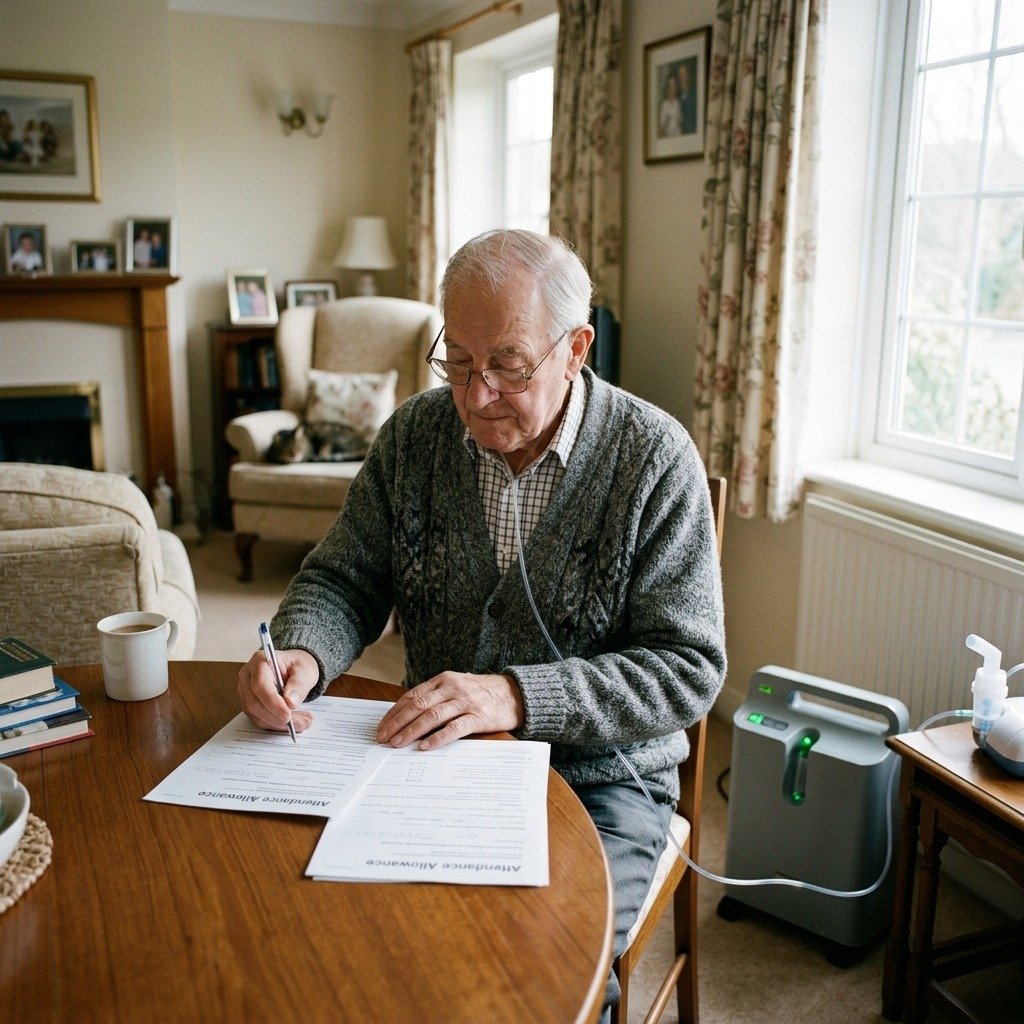
Oxygen concentrators require filters to be cleaned, cannulas to be changed, and tubing to be checked. For someone who is short of breath at rest, these tasks may require assistance. Any malfunction also needs someone able to respond quickly.
Oxygen and Cooking Fire Risk Supervision
Using a gas hob or lighting a flame near supplemental oxygen carries a serious fire risk. Many people on LTOT cannot safely cook alone. This creates a constant, daily supervision need that directly supports an AA claim both at the lower and higher rate depending on frequency.
Someone Needing to Fetch Portable Cylinders
Portable cylinders are heavy. A person who cannot carry their own ambulatory oxygen cylinder needs someone present to move equipment another concrete, recurring care task.
Nebuliser Supervision Requirements
Nebuliser Preparation and Cleaning
Loading a nebuliser chamber, measuring medication, and cleaning the device after each use requires manual dexterity and concentration. For someone breathless or fatigued from COPD, this may need assistance or prompting, particularly several times per day.
Peak Flow Monitoring
Tracking peak flow readings requires correct technique and recording. Cognitive fatigue, breathlessness, or poor dexterity may mean another person needs to assist with measurement or log the results.
Pulse Oximetry Checks
Regular fingertip oximetry checks are commonly used to monitor oxygen saturation between nebuliser doses. Interpreting the reading and deciding whether to seek help requires support for many people, particularly during exacerbations.
Response to Reduced Oxygen Saturation
When saturations drop whether during activity or at rest a person may need someone present to fetch inhalers, administer nebulised medication, call for help, or decide whether emergency services are required. This is a safety supervision need of the most direct kind.
Exacerbation Frequency as a Care Need
Frequent Exacerbations (2+ Per Year) and Standby Support
Research published by the National Emphysema Foundation estimates annual exacerbation rates of approximately 1.61 for people with severe COPD and 2.10 for very severe COPD. Two or more exacerbations per year that require GP or hospital intervention demonstrate that the condition is not stable and that care needs fluctuate unpredictably.
Emergency Inhaler Use Needing Someone to Assist
During an acute episode, a person may be too breathless to operate a pressurised inhaler correctly, requiring someone to help them position a spacer, time the actuation, or remain present while the reliever takes effect.
Rescue Steroid Pack Management Memory and Timing
Many people with COPD keep a rescue pack of prednisolone and antibiotics at home. Recognising the symptoms that trigger their use, taking them at the correct time, and completing the course requires either intact cognition and recall or help from another person. This is both a care need and a medication supervision need.
Hospital Admission History as Evidence
A GP letter or discharge summary documenting two or more hospital admissions for COPD exacerbations strengthens a claim significantly. The DWP treats admission history as evidence that care needs are real and recurring.
Nocturnal COPD and the Higher-Rate Case
Waking Breathless Sitting Up Urgently
Nocturnal breathlessness waking suddenly short of breath and needing to sit upright is common in moderate to severe COPD. If this happens regularly, another person in the household may need to rouse, help reposition, or assist with medication. This is a night-time care need that supports the higher rate.
Nocturnal Cough and Sputum Clearance
Overnight coughing and mucus production can require support with positioning, tissue management, or simply another person being alert to whether the episode escalates.
Nocturnal Desaturation and CPAP/BiPAP
People with COPD who also experience nocturnal hypoventilation or overlap syndrome may use BiPAP at night. Fitting the mask, managing alarms, and responding to desaturation during sleep all represent night-time supervision needs.
3am Nebuliser Treatments During Flare-Ups
During exacerbations, nebuliser treatments may be needed in the middle of the night. This involves someone preparing the device, measuring medication, and staying present during administration. Even if the claimant manages the nebuliser themselves, having another person awake and available is itself a demonstrable night need.
Someone Awake in Case of Respiratory Arrest
In the most severe cases, the risk of sudden respiratory deterioration during sleep means a family member or carer may not sleep soundly. If there is a documented need for someone to be alert throughout the night, this underpins the highest level of night supervision and strengthens a higher-rate claim.
Weak vs Strong COPD AA1 Wording 12 Examples
| Task | Weak Wording | Strong Wording |
| Bathing | “I get a bit breathless in the shower” | “After two minutes in a hot shower I become acutely breathless and need to sit on a shower chair; my wife stays in the bathroom in case I become too short of breath to call for help” |
| Dressing | “Bending is difficult” | “Putting on socks causes my oxygen saturation to drop below 88%; I need to pause for 4–5 minutes and often need my husband to put my shoes on for me” |
| Kitchen with oxygen | “I can’t cook as easily as I used to” | “I cannot use the gas hob while on oxygen due to fire risk; my daughter prepares all hot meals because I am unable to cook safely without supervision” |
| Nebuliser prep | “I use a nebuliser” | “I use my nebuliser three times a day; my hands shake and I have difficulty measuring the saline accurately, so my son prepares the medication chamber for each dose” |
| Medication timing | “I sometimes forget my tablets” | “I need prompting to start my rescue prednisolone course at the correct time; last year I delayed starting it by three days because I didn’t recognise the signs of an exacerbation early enough” |
| Night breathlessness | “I sometimes wake up at night” | “I wake two to three nights per week acutely breathless; my wife has to help me sit upright, bring my reliever inhaler, and stay with me for up to 30 minutes until my breathing settles” |
| Walking to toilet | “Walking is hard” | “The toilet is eight metres from my bedroom; I have to stop halfway for breath, which means I sometimes do not make it in time, and my carer often accompanies me to ensure I don’t fall” |
| Meal prep | “I can’t do much cooking” | “I can stand for no more than two minutes before I must rest; preparing a sandwich requires three separate rest stops and often takes 20 minutes, meaning I frequently skip meals when alone” |
| Reduced saturation | “I check my oxygen levels” | “When my fingertip monitor reads below 90% my daughter calls the GP; I cannot make this call myself when breathless because I am unable to speak clearly enough to be understood” |
| Exacerbation signs | “I get chest infections” | “I have had four hospital admissions in the past 18 months; my wife monitors my sputum colour and breathing rate daily because I do not always recognise when I need emergency help” |
| Indoor mobility | “Moving around is tiring” | “Walking from the living room to the bathroom (12 metres) requires me to stop twice; I use furniture to steady myself and need someone available in case I become dizzy or fall” |
| Sleep position | “I can’t lie flat” | “I sleep propped at 45 degrees with three pillows; if I slip down during the night I wake in respiratory distress and need someone to help reposition me immediately” |
Evidence to Strengthen a COPD Claim
The most impactful supporting documents to attach to an AA1 form for a COPD claim include:
- Respiratory consultant clinic letter confirms diagnosis, current treatment, and functional limitations
- Spirometry results FEV1, FVC, and FEV1/FVC ratio confirm GOLD stage and severity
- CT scan report emphysema documentation provides objective evidence of structural lung damage
- Home Oxygen Assessment report a BTS Home Oxygen Service report is particularly powerful, as it confirms clinical need for oxygen and the hours prescribed
- Pulmonary rehabilitation discharge summary documents what a person could and could not achieve, often including walking test results
- GP QOF records COPD quality outcomes framework records show exacerbation frequency and intervention history
- Community respiratory team letters respiratory nurse or physiotherapist letters describing home visits add weight to care need descriptions
COPD Comorbidities That Strengthen the Claim
Right Heart Failure (Cor Pulmonale)
Pulmonary hypertension secondary to COPD causes right heart failure in some people. This adds fluid retention, fatigue, and cardiovascular limitations on top of breathlessness, significantly increasing care needs.
Peripheral Oedema and Mobility
Leg swelling associated with cor pulmonale reduces mobility further and may require daily compression bandaging a task many people cannot manage independently.
Anxiety and Panic from Breathlessness
Breathlessness provokes anxiety, and anxiety worsens breathlessness. Many people with COPD require someone present during breathless episodes not only for physical help but to prevent panic escalation. This psychological care need is legitimate and claimable.
Weight Loss and Cachexia
Advanced COPD is associated with significant unintentional weight loss. This increases fatigue, reduces muscle strength, and adds a nutritional supervision or assistance need.
Osteoporosis from Steroid Use
Repeated courses of oral corticosteroids for exacerbations or long-term inhaled steroids increase fracture risk. Someone already breathless at rest who also has vertebral or hip fracture risk needs additional mobility supervision, particularly on stairs and in the bathroom.
COPD-Specific Pitfalls to Avoid
- Describing average days, not exacerbation days. The DWP assesses needs over a range of days. Describe your worst typical days, not your best.
- Underplaying oxygen dependence. Phrases like “I just use a bit of oxygen” minimise a significant clinical and practical need. Describe exactly how many hours per day, what equipment, and what help you need with it.
- Missing the shower and bath breathlessness link. Many claimants don’t connect heat and humidity with their worst breathlessness episodes this is one of the strongest COPD-specific care needs and should be described in detail.
- Not mentioning night-time symptoms. Nocturnal waking, early morning cough, overnight saturation drops, and 3am nebuliser use are all invisible to a DWP assessor unless you describe them explicitly.
- Focusing on FEV1 alone without functional impact. Spirometry figures mean little to a decision maker. Always translate clinical measurements into what you cannot do or cannot do safely alone.
Frequently Asked Questions
Does mild-to-moderate COPD (MRC Grade 1–3) qualify for Attendance Allowance?
Not usually on breathlessness alone. However, frequent exacerbations, comorbidities such as cor pulmonale, anxiety triggered by breathlessness, or significant medication supervision needs can support a claim even at Grade 2–3. Always consider the full picture, not the spirometry result alone.
Do I need to be on oxygen to claim Attendance Allowance for COPD?
No. Oxygen therapy strengthens a claim, but it is not required. The question is whether your COPD at whatever stage creates a need for help or supervision with personal care tasks, day or night.
Does using a walking aid strengthen my COPD claim?
It can, particularly if the walking aid is needed indoors between rooms, to the bathroom because it demonstrates that breathlessness-related mobility limitations affect daily personal care, not just outdoor walking.
What if my COPD is well controlled with inhalers?
Good inhaler adherence does not mean you have no care needs. Describe what you need help with despite optimal treatment. The DWP is not assessing whether your condition could be better managed it is assessing what you need now.
Can I claim Attendance Allowance if I still smoke?
Yes. Smoking history or current smoking does not disqualify a claim. Attendance Allowance is based on care needs, not lifestyle choices or treatment compliance.
Does exacerbation frequency affect my Attendance Allowance claim?
Yes, significantly. Two or more exacerbations per year that require GP or hospital intervention demonstrate that your condition is unpredictable and that standby supervision is a real and recurring need particularly during and after acute episodes.
What if I’ve had a lobectomy or lung volume reduction surgery?
Post-surgical COPD or emphysema may involve different functional limitations. Describe what you can and cannot do now, post-surgery, and attach any discharge summary or follow-up clinic letters that document your current functional capacity.
Do I need spirometry results to make a successful COPD claim?
No spirometry strengthens a claim but is not mandatory. Attendance Allowance is awarded based on care needs, not clinical test results. That said, including FEV1 data alongside a clear description of functional impact gives decision makers both the clinical and the human picture.