Attendance Allowance and Housing Benefit: What Changes After AA
Receiving Attendance Allowance (AA) can significantly increase your Housing Benefit in three ways: AA income is fully disregarded, your applicable amount rises through disability premiums, and any non-dependant deductions are waived entirely. The net result is often a meaningful increase in your weekly Housing Benefit award without a new claim.
How Attendance Allowance Changes Your Housing Benefit Calculation
Most people assume that because AA is extra income, it will reduce their Housing Benefit. The opposite is true. Three distinct changes work in your favor the moment your AA award is confirmed.
AA is disregarded as income
Attendance Allowance is fully disregarded when your local council calculates your Housing It does not count as income. Your benefit is calculated as if you don’t receive it at all.
Your applicable amount increases
The “applicable amount” is the weekly figure the DWP uses to represent your basic living needs. When you receive AA, you become entitled to disability premiums that are added directly onto your applicable amount raising the ceiling against which your income is measured, and therefore increasing the Housing Benefit you can receive.
The net effect is more Housing Benefit
Because AA itself doesn’t count as income, and your applicable amount goes up, the gap between what the council expects you to need and what your assessable income covers widens. That gap is filled by Housing Benefit. The result is a higher award.
The three specific changes in your assessment
To summarize concisely, when you are awarded AA your Housing Benefit calculation changes in these ways:
- AA income is removed from the income side of the calculation
- A disability premium (and potentially a severe disability premium) is added to your applicable amount
- Any non-dependant deductions are removed entirely
A worked example
Imagine a single pensioner paying £150/week rent. Before AA, their Housing Benefit covers the gap between their applicable amount and their assessed income. After AA is awarded, their applicable amount increases by the single disability premium (£44.85/week as of April 2026). The AA income itself is not counted. And if an adult child lives with them, the non-dependant deduction previously reducing their award disappears. Together, these three changes can add £60–£100+/week to a Housing Benefit award, depending on circumstances.
The Disability Premium in Housing Benefit
When you receive AA, you qualify for disability premiums that are added to your applicable amount. These are distinct from AA itself they are Housing Benefit-specific additions.
Single claimant disability premium
As of April 2026, the single claimant disability premium stands at £44.85/week For couples, the couple disability premium is £64.00/week.
Severe disability premium
The severe disability premium is a separate, higher addition. To qualify, you must receive AA (or a qualifying disability benefit), live alone or with no one receiving Carer’s Allowance for you, and have no non-dependant adults in the home. As of April 2026, the severe disability premium is £86.05/week for a single claimant and £172.10/week for couples where both qualify. This is one of the largest single additions available in the Housing Benefit applicable amount.
Enhanced disability premium
If you receive the higher rate of AA, you may also qualify for the enhanced disability premium on top of the standard disability premium. As of April 2026, this is £22.00/week for a single claimant and £31.40/week for a couple.
How premiums stack up
Premiums are not mutually exclusive. A higher-rate AA recipient living alone, with no carer and no non-dependants, could potentially qualify for the standard disability premium, the enhanced disability premium, and the severe disability premium simultaneously adding over £150/week to their applicable amount before any income is even assessed.
Pensioner premiums vs. working-age premiums
Pensioners still use the legacy Housing Benefit system, not Universal Credit. The premium structure above applies to both working-age claimants and pensioners on Housing Benefit, though pensioners have higher base personal allowances (£256.00/week for a single pensioner who reached pension age before 1 April 2021, or £238.00/week for those who reached pension age on or after that date, per Shelter, 2026).
Non-Dependant Deduction Waivers
This is one of the least-known but most financially significant effects of an AA award.
What are non-dependants in Housing Benefit?
A non-dependant is any adult who lives with you who is not your partner a grown-up child, a sibling, a friend. The council assumes they contribute toward your rent, whether they do or not.
The standard deductions
Without AA, non-dependant deductions can substantially reduce your Housing Benefit. From April 2026, the deductions range from £20.40/week for a non-dependant with no income, up to £131.45/week for one earning £605 or more per week (according to Shelter, 2026). For a pensioner with a working adult child living at home, this deduction alone could eliminate most of their Housing Benefit.
How AA waives non-dependant deductions completely
Once you or your partner receive AA, the council must stop making non-dependant deductions entirely regardless of how many non-dependants live with you or how much they earn. This isn’t a discretionary concession; it’s a legal requirement under the Housing Benefit Regulations.
How to notify your council
The waiver is not automatic if your council doesn’t know about your AA award. Contact your local Housing Benefit department as soon as your AA is confirmed and ask them to remove all non-dependant deductions. Bring your AA award letter and provide it in writing. If you’ve been losing money to these deductions since your AA award date, you may be entitled to a backdated correction.
Council Housing vs. Private Rental Different Impacts
Where you rent determines how far your increased Housing Benefit actually goes.
Social housing
If you rent from a council or housing association, Housing Benefit can cover up to your full eligible rent which means the premium-driven increases in your applicable amount directly reduce the amount you pay out of pocket. For many pensioners in social housing, the combined effect of disability premiums and the non-dependant deduction waiver can result in Housing Benefit covering the entire rent.
Private rental and Local Housing Allowance (LHA) rates
In the private sector, Housing Benefit is capped by the Local Housing Allowance the rate set for your area and bedroom category. Regardless of how much your premiums increase your applicable amount, your Housing Benefit cannot exceed the LHA rate for your property type.
Bedroom entitlement and disability
AA claimants may qualify for an additional bedroom entitlement if they require overnight care or cannot share a room due to their disability. If your bedroom entitlement increases, your LHA rate is calculated on that higher bedroom category, which raises the cap and potentially allows more of your applicable amount to be met.
Discretionary Housing Payment (DHP) The Backup Route
When your Housing Benefit doesn’t cover your full rent because the LHA cap limits your award a Discretionary Housing Payment can fill the gap.
What DHP covers
DHP is a short-term award made by your local council from a limited annual fund. It can cover the shortfall between your Housing Benefit and your actual rent. It is not an entitlement it’s discretionary but AA claimants are consistently among the strongest candidates.
Why AA claimants qualify
Councils prioritize DHP applications where the claimant has a disability, faces hardship, and has few alternative options. An AA award is strong evidence of disability need. In your DHP application, clearly set out how your care needs make it difficult or impossible to move to cheaper accommodation, and include your AA award letter as supporting evidence.
Time-limited awards and renewals
DHP awards typically run for a fixed period often 12 weeks to one year. You can reapply, but each application is assessed on current circumstances. Keep a record of your previous award when reapplying.
How to Trigger the Housing Benefit Reassessment
Receiving AA doesn’t automatically update your Housing Benefit. You need to take action.
Notify your council within four weeks of your AA award
Contact your local Housing Benefit department as soon as your award letter arrives. Most councils require notification of a change in circumstances within four weeks. Missing this window can delay your increased payment and complicate backdating.
What paperwork to send
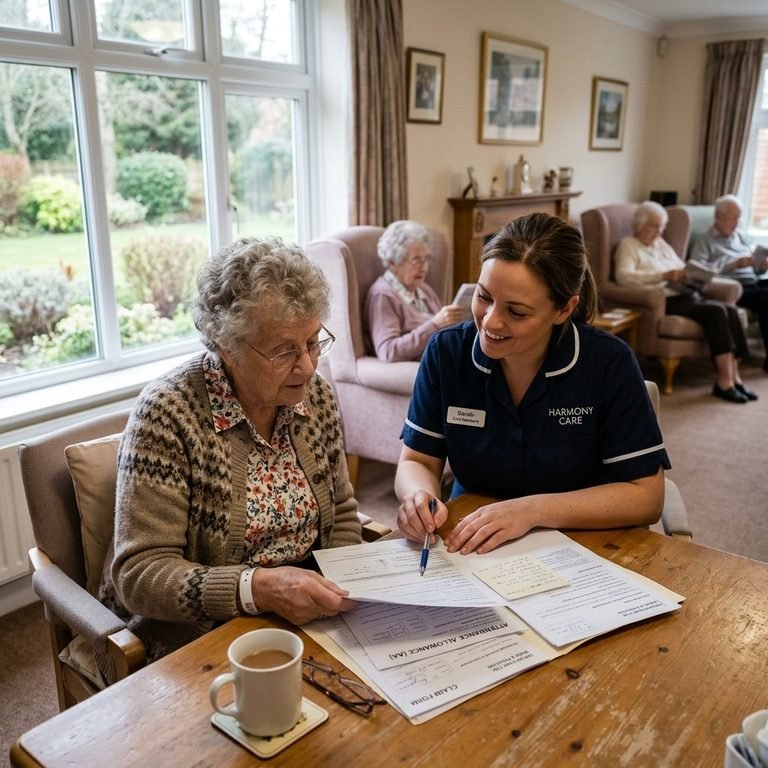
Send a copy of your AA award letter along with a completed change-of-circumstances form (available from your council). Note the AA start date clearly this is the date from which your reassessment should take effect.
Backdating rules
If you notified your council promptly, the reassessment should be backdated to your AA award date. If you missed the four-week window, backdating becomes more complicated and may depend on whether you have a good reason for the delay.
The Housing Benefit and Pension Credit Overlap
If you receive Pension Credit Guarantee Credit, you are passported directly to maximum Housing Benefit meaning your rent is covered in full regardless of your other income or savings. AA can also trigger a Pension Credit claim if you haven’t already made one, since it activates the severe disability addition to Pension Credit. If you’re not yet receiving Pension Credit, consider applying for both simultaneously through your local council or the Pension Service.
Council Tax Reduction The Companion Benefit
Council Tax Reduction is a separate scheme from Housing Benefit but is often applied for at the same time through the same council form. AA can affect your Council Tax Reduction calculation in a similar way to Housing Benefit increasing your applicable amount and potentially triggering a disability premium within that scheme. There is also a separate Council Tax Disability Reduction, which can move your property down a council tax band if you have a room, or an extra space in the home, specifically needed because of a disability.
Housing Benefit Rules for Care Homes
Housing Benefit does not cover care home fees. If you move permanently into a care home, your Housing Benefit for your former home will stop. However, if the move is temporary for respite care or rehabilitation Housing Benefit can continue for up to 52 weeks in some cases. If you are trialing a care home placement and still have tenancy obligations on your original home, get advice immediately about the two-homes rules, which in exceptional cases allow Housing Benefit to cover two properties simultaneously.
Universal Credit vs. Housing Benefit for Pensioners
Pensioners continue to claim Housing Benefit through the legacy system, not Universal Credit. This matters because the premium structure described throughout this article disability premiums, severe disability premiums, enhanced disability premiums does not exist within Universal Credit in the same form. If you are State Pension age and currently claiming Housing Benefit, an AA award improves that existing claim. If you are part of a mixed-age couple (one partner under State Pension age), different rules may apply seek advice from your local council or Citizens Advice before making changes to your claim.
Frequently Asked Questions
Does Attendance Allowance affect my Housing Benefit?
Yes, but positively. Attendance Allowance is fully disregarded as income in the Housing Benefit calculation. It also triggers disability premiums that increase your applicable amount, and it removes non-dependant deductions entirely. The combined effect is almost always a higher Housing Benefit award.
How much extra Housing Benefit will I get with AA?
The exact figure depends on your circumstances income, household composition, and whether you qualify for the severe disability premium. The single disability premium alone adds £44.85/week to your applicable amount (from April 2026). If non-dependant deductions were previously applied, removing those can add a further £20.40–£131.45/week depending on your non-dependant’s income.
Do I have to reapply for Housing Benefit when I get AA?
No you do not need to make a new claim. You need to notify your council of the change in circumstances using a change-of-circumstances form and provide your AA award letter. The council will then reassess your existing claim.
Will my adult child’s income affect my Housing Benefit now that I have AA?
No. Once you receive AA, the council must remove all non-dependant deductions, regardless of how much your adult child earns or how many non-dependants live with you.
Can I get Housing Benefit, Pension Credit, and AA together?
Yes. These are three separate entitlements. Receiving all three is both legal and common among older people with care needs. In fact, receiving Pension Credit Guarantee Credit while also receiving AA means you are passported to maximum Housing Benefit.
What if my rent is above the LHA rate?
If you rent privately and your rent exceeds the Local Housing Allowance cap, Housing Benefit will not cover the full shortfall regardless of your AA status. In this situation, apply for a Discretionary Housing Payment from your local council. AA is strong supporting evidence for a DHP application.
Does AA help with Council Tax as well?
AA can increase your Council Tax Reduction by triggering disability premiums within that scheme. A separate Council Tax Disability Reduction scheme may also reduce your band if you have specific disability-related space needs. These are separate applications contact your council for details.
Do I qualify for Housing Benefit if I own my home?
No. Housing Benefit is only available to people who pay rent. Homeowners are not eligible, regardless of AA status. If you own your home and receive AA, look into whether you qualify for Pension Credit, Council Tax Reduction, or other disability-linked support.

One Comment