Attendance Allowance Dementia and Alzheimer’s: Eligibility, Rates & Claims
Dementia and Alzheimer’s disease almost always qualify for the higher rate of Attendance Allowance currently £114.60 per week (2026/27) because dementia-related supervision needs typically exist both day and night.
Why Dementia Almost Always Wins the Higher Rate
The higher rate of Attendance Allowance (£114.60/week in 2026/27) requires that a claimant needs help or supervision both during the day and during the night. For dementia, this is not an edge case it is the norm.
During the day, people with dementia typically need continual supervision to prevent harm: wandering, leaving gas hobs on, responding to doorstep scammers, missing meals, or double-dosing medication. At night, sleep-wake reversal, nocturnal wandering, and confusion on waking frequently mean a carer must remain awake or alert to intervene. Both day and night needs are present simultaneously in most moderate-to-severe presentations.
The lower rate (£76.70/week) applies where supervision is needed only in the day or only at night, but not both. This is uncommon with dementia beyond the early stage. According to Dementia UK, the majority of dementia claimants who describe their needs accurately receive the higher rate.
Applying on Behalf of Someone with Dementia Legal Pathways
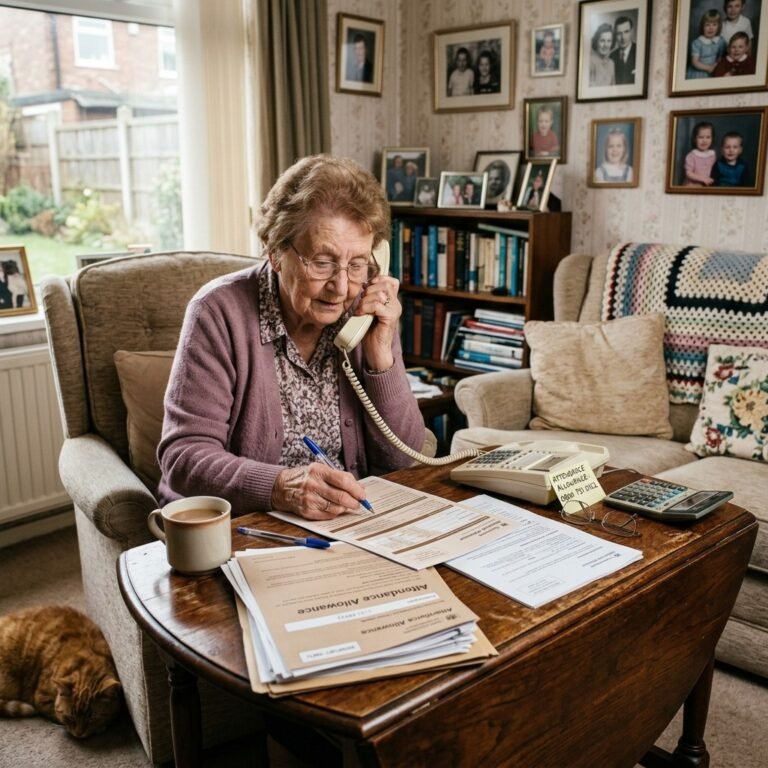
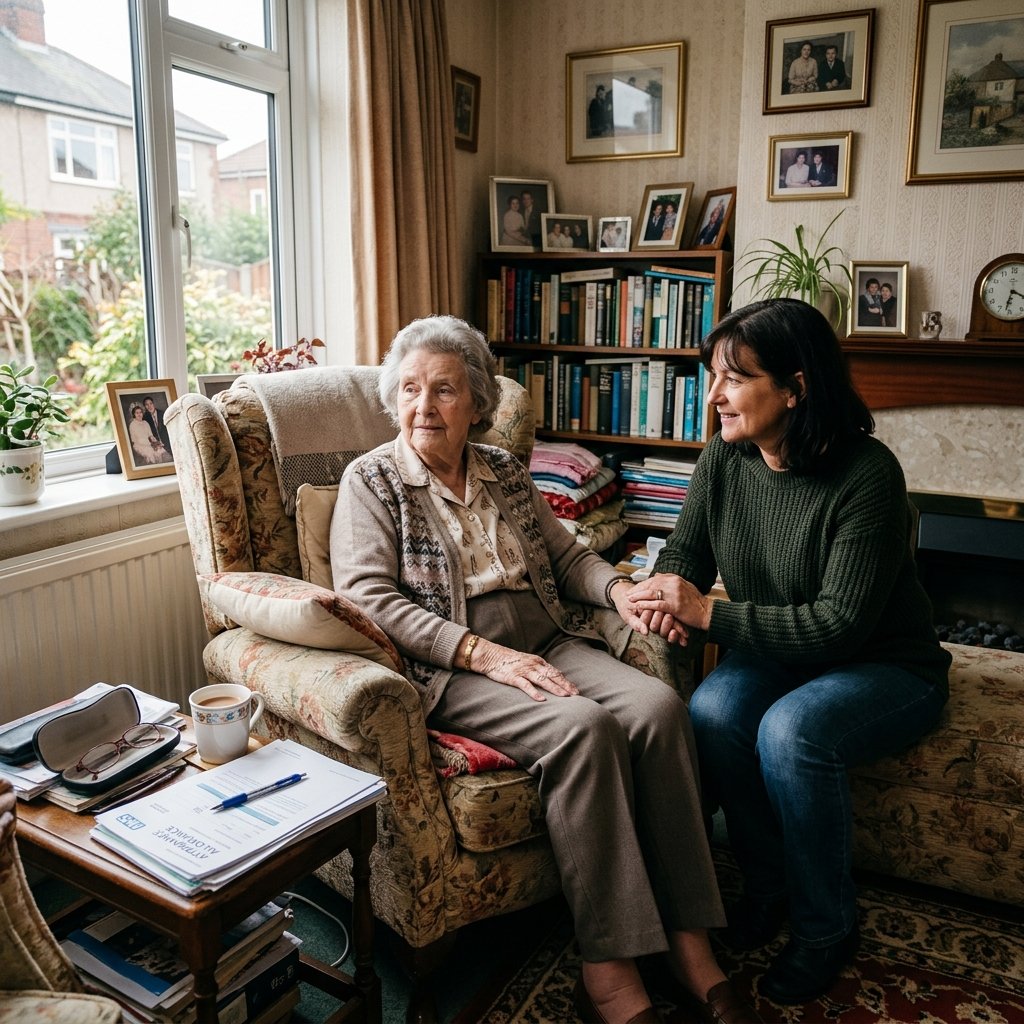
One of the most confusing parts of claiming for a family member is understanding who has the authority to sign and submit the form. The answer depends on the person’s current mental capacity.
Applying with the Person’s Consent (Early-Stage Dementia)
At diagnosis or in early-stage dementia, many people retain full capacity to make decisions. They can fill in the form themselves, ask a family member to help complete it, and sign it personally. This is the simplest path and requires no additional legal steps.
Lasting Power of Attorney (LPA) Property & Finance vs Health & Welfare
There are two types of LPA. A Property and Financial Affairs LPA authorises the attorney to manage money, property, and financial decisions including applying for benefits like Attendance Allowance. A Health and Welfare LPA covers medical and care decisions, but does not specifically authorise financial applications. For AA purposes, the Property and Financial Affairs LPA is the relevant document. The attorney can sign the form and correspond with DWP on the claimant’s behalf.
An LPA must be registered with the Office of the Public Guardian before it can be used.
DWP Appointee Status (When There Is No LPA)
If no LPA exists but the person lacks capacity, a family member or carer can apply to become a DWP Appointee. This is done by contacting the Disability Living Allowance helpline and requesting a home visit. An appointee can manage Attendance Allowance on the claimant’s behalf but crucially, this covers that one benefit only. If you also need to manage their pension, bank account, or other benefits, separate applications are needed for each.
Court of Protection Deputy (for Those Who Lack Capacity Without LPA)
Where no LPA was set up and the person now lacks capacity, a Court of Protection Deputy order grants broader financial decision-making authority. The application fee is currently £421. This is the most comprehensive legal route but also the most time-consuming. For AA specifically, DWP Appointee status is faster and sufficient.
Decision Framework: Which Authority Do You Have?
- Person can sign themselves? Apply directly, with family support if needed.
- LPA (Property & Finance) registered? Attorney signs attach a certified copy of the LPA.
- No LPA, person lacks capacity? Apply for DWP Appointee status for AA specifically.
- Broader financial management needed? Court of Protection Deputy order required.
DWP will need to see a certified copy of any LPA or Appointee confirmation letter before processing a claim where someone other than the claimant is signing.
Describing Supervision Needs on the AA1 The Dementia-Specific Language DWP Recognises
The AA1 form asks about care needs in specific categories. For dementia, the framing matters enormously. DWP decision-makers distinguish between two legal tests: “frequent attention” (help with physical tasks at regular intervals) and “continual supervision” (an ongoing need to watch over someone to prevent danger). Dementia typically triggers the continual supervision test which is a stronger qualification basis.
Wandering Behaviour and Door Alarms
Describe the frequency, the risk, and the outcome without supervision: “She leaves the house without awareness of danger and has been found two streets away twice in the last month. A door alarm alerts her carer, who must be present and awake at all times to prevent harm.”
Kitchen Safety
“He turns on the gas hob and forgets to return to it. He has twice left an unlit ring burning. He cannot be left unsupervised in the kitchen at any time.”
Medication Non-Compliance
“She forgets she has already taken her medication and attempts to take it again. She also refuses to take medication on some days. Her carer must supervise each dose twice daily and keep all medications locked away.”
Sundowning and Evening Confusion
“From approximately 4pm, she becomes significantly more confused, agitated, and distressed. She does not recognise her home environment and has attempted to leave on several occasions. She requires continuous supervision from late afternoon until she settles at night.”
Response to Strangers and Phone Scams
“He responds to any caller at the door or by phone as though they are trusted acquaintances. He has given his bank details to a phone caller and signed documents without understanding them. He cannot be left alone when callers arrive.”
Ability to Summon Help and Recognition of Family Members
Note if the person cannot reliably operate a phone, use an alarm pendant, or would not recognise a situation as an emergency. Also document any decline in recognising close family this is relevant to establishing the degree of cognitive impairment.
Dementia Stages and Attendance Allowance Rate
| Stage | Typical Care Needs | Typical AA Rate | Key Documentation |
| Mild Cognitive Impairment (MCI) | Prompting with medications and appointments; memory aids in place | Lower rate or declined | MCI diagnosis letter; MMSE/MoCA score |
| Mild Dementia | Daily prompting; safety concerns emerging; capable of some self-care | Lower rate (sometimes higher if night needs documented) | Diagnosis letter; cognitive test scores; GP summary |
| Moderate Dementia | Personal care assistance; continual day supervision; night supervision likely | Higher rate (most cases) | Consultant letter; care plan; incident log |
| Severe Dementia | Full personal care; constant supervision day and night; may be immobile | Higher rate; may qualify for Special Rules (end of life) | Consultant and GP letters; SR1 if appropriate |
MCI alone rarely qualifies for higher rate without documented safety incidents. Always describe the worst day, not the best.
Weak vs Strong AA1 Wording for Dementia (15 Examples)
| Need | Weak Wording | Strong Wording |
| Forgetting medications | “Sometimes forgets her tablets” | “She forgets whether she has taken medication and attempts to double-dose daily. Her carer locks all medication and supervises every dose morning and night.” |
| Wandering at night | “Gets up in the night sometimes” | “He leaves the bedroom confused three to four nights per week and has twice been found in the garden at 2am. His carer must remain alert throughout the night.” |
| Prompting to eat | “Needs reminding about meals” | “She does not recognise hunger or remember whether she has eaten. Without supervision she has gone without food for a full day. Her carer prepares every meal and sits with her.” |
| Safety hazards left | “Occasionally leaves appliances on” | “He leaves the gas hob and kettle on unattended multiple times per week. He cannot be left unsupervised in the kitchen due to fire and burn risk.” |
| Personal hygiene neglect | “Doesn’t always wash” | “She does not initiate washing and resists attempts to help her. Her carer must provide full assistance with bathing three times per week, including prompting, undressing, and direct supervision.” |
| Dressing inappropriately | “Sometimes wears wrong clothes” | “She dresses in summer clothes in winter and has left the house in nightclothes. Her carer must select and assist with clothing every morning.” |
| Incontinence with lack of awareness | “Has accidents” | “He is incontinent of urine and bowel and is unaware this has occurred. His carer provides full personal care including washing, pad changes, and laundering on average four times per day.” |
| Agitation requiring calming | “Gets upset and confused” | “She becomes severely agitated, shouting and occasionally striking out, for one to two hours most evenings. Her carer must remain present to de-escalate and prevent self-injury.” |
| Sleep-wake reversal | “Sleeps at odd times” | “He is awake and active between 1am and 4am most nights, attempting to dress and leave the house. His carer must be awake during these periods to ensure safety.” |
| Confusion around bathing | “Doesn’t like baths” | “She does not understand what a bath is for and becomes frightened during bathing. Her carer requires up to 45 minutes to complete bathing with full hands-on assistance.” |
| Supervision on stairs | “Gets a bit unsteady” | “She misjudges the top of the staircase and has fallen twice. She requires hand-to-hand guidance and supervision on every stair descent.” |
| Forgetting to drink | “Doesn’t drink enough” | “He does not perceive thirst and has twice been hospitalised with dehydration. His carer sets alarms and physically offers drinks every two hours throughout the day.” |
| Difficulty recognising family | “Sometimes confused about people” | “She regularly fails to recognise her daughter, treating her as a stranger. This causes significant distress and requires patient re-introduction each visit.” |
| Response to fire alarm | “Would need help if there was a fire” | “He does not respond to auditory alarms and would not take action in an emergency. He could not evacuate safely without direct physical guidance from another person.” |
| Telephone use | “Struggles with the phone” | “She cannot reliably dial or answer a phone. She cannot be relied upon to call for help in an emergency and cannot screen calls she has given bank details to unknown callers twice.” |
Night Supervision Needs The Critical Section for Dementia
Night needs are what convert a lower-rate claim to a higher-rate award. This section of the AA1 is frequently underdescribed.
Sleep-wake pattern reversal is common in moderate-to-severe dementia. The person may be active and confused at 2am, attempting to dress, cook, or leave the house.
Night wandering is particularly dangerous. Many families install door alarms or stairgate locks but note that DWP does not consider physical barriers as removing the need for supervision. The carer must still be awake and available to respond.
Confusion on waking means the person does not know where they are, what time it is, or who is present. This requires immediate, calm intervention that cannot be provided by an absent carer.
Nocturnal incontinence with lack of awareness means the person wakes wet or soiled and does not register this has occurred. Full personal care is needed in the night.
Fall risk during night trips to the toilet is high in dementia due to disorientation in the dark and impaired spatial awareness. The carer must accompany every night-time trip to the bathroom.
DWP asks whether another person needs to be awake for a prolonged period or at frequent intervals to watch over the claimant. Simply being in the house, asleep, does not satisfy this test. Describe what the carer actually does during the night, how often, and for how long.
Evidence to Strengthen a Dementia Claim
Strong claims attach supporting documentation rather than relying on the form alone. Useful evidence includes:
- Memory clinic diagnosis letter confirming the type of dementia (Alzheimer’s, vascular, Lewy body, frontotemporal) and date of diagnosis
- MMSE, ACE-III, or MoCA scores cognitive test scores from clinic visits document the degree of impairment on record dates
- Consultant psychiatrist or geriatrician letters particularly those describing functional decline, insight loss, or behavioural symptoms
- Admiral Nurse reports Admiral Nurses are dementia-specialist nurses; their clinical notes carry significant weight with DWP assessors
- Social services care needs assessment formally documents care requirements as assessed by a professional
- GP annual dementia review summary provides a baseline record of the person’s current functional status
- Community Mental Health Team (CMHT) notes relevant where behavioural and psychological symptoms (BPSD) have been assessed
- Incident documentation a written log of specific incidents (found in the garden at night, gas left on, hospital admission for dehydration) is more persuasive than general statements about risk
Always explain to DWP assessors that the person cannot give an accurate account of their own needs insight loss is a core feature of dementia, and self-reporting is unreliable.
Interaction with Other Support
Dementia and Council Tax Exemption (Class U Severe Mental Impairment)
Receiving Attendance Allowance is one of the qualifying benefits for the severe mental impairment disregard for Council Tax. If a GP certifies that the person meets the severe mental impairment criteria, and they are in receipt of AA, they can be disregarded for Council Tax purposes entirely. If they live alone, the property becomes exempt (Class U no Council Tax payable). In Wales, this is now called “Significant Cognitive Impairment” (SCI) from April 2026, with a revised definition. This can be backdated to the date of diagnosis in Wales and often to when criteria were first met in England.
NHS Continuing Healthcare and AA
NHS Continuing Healthcare (CHC) is funded care for people with a primary health need. If a person is awarded CHC funding in a care home or at home, Attendance Allowance stops the NHS is meeting the care need. However, during a CHC assessment process or where CHC has been refused, AA should continue. Families pursuing CHC for dementia can claim AA in parallel without prejudicing the CHC application.
Community Mental Health Team Involvement
CMHT involvement is not just evidence it can also unlock additional care packages and, in some areas, specialist dementia care coordinators who can assist with benefit applications directly.
Local Authority Care Packages and AA
AA does not reduce or affect a Local Authority care package. It is not means-tested and is not counted as income when a financial assessment for care contributions is carried out.
Applying After a Care Home Move
AA stops after 28 days in a care home where the Local Authority is funding or part-funding the placement. This is because the AA becomes payable to the local authority rather than the individual.
Self-funders those paying their own care home fees can continue to receive Attendance Allowance, and it can contribute toward the fees. Notify DWP as soon as circumstances change, both on entry and if funding arrangements shift from self-funded to LA-funded.
Where a family member pays a third-party top-up above the LA’s rate, AA can still be payable to the individual if the LA is not meeting the full cost. Specialist benefits advice is recommended in top-up situations.
Dementia-Specific Pitfalls
Describing capability in company. Many people with dementia perform significantly better in a formal assessment or when visitors are present. Family carers often inadvertently describe their relative’s best presentation. Always describe what happens on a typical or bad day without support.
The “good day” phenomenon in early-stage dementia. Early dementia is characterised by fluctuation. Carers sometimes understate needs because the person seemed fine last week. DWP assesses eligibility over a six-month period describe the full range of need, including on difficult days.
Conflating “prompted” with “independent.” If the person can dress themselves after a carer lays out the clothes and gives repeated verbal instructions, they are not dressing independently. DWP’s test includes the need for prompting and supervision, not just physical hands-on assistance.
Assuming the person must attend an assessment. DWP can and does make decisions on paper for dementia claims, particularly with strong supporting evidence. A home visit assessor if sent is not there to quiz the claimant. They observe and gather information. The claimant does not need to perform or answer formal questions.
Frequently Asked Questions
Can I claim Attendance Allowance for my parent without their permission?
If your parent retains mental capacity, they must consent to the claim and sign the form. If they lack capacity, you can apply as a DWP Appointee or as an attorney under a registered Property and Financial Affairs LPA.
Does mild cognitive impairment (MCI) qualify for Attendance Allowance?
MCI alone rarely qualifies unless there are documented safety concerns requiring supervision. If your parent has MCI but needs someone to prevent them from harm during the day or night, describe those specific needs. A diagnosis label is not what DWP awards care needs are.
What is the DWP Appointee process?
Contact the DWP Disability Benefits helpline and request an appointeeship assessment. A DWP officer will visit your parent at home to confirm they lack capacity, then register you as appointee. This grants authority to manage that specific benefit only.
Does my parent need a formal dementia diagnosis to apply?
No. A formal diagnosis can strengthen the claim, but AA is awarded based on care needs, not diagnosis. If your parent has undiagnosed cognitive decline that generates supervision needs, you can still apply and attach supporting evidence from a GP.
Can we claim Attendance Allowance if my parent lives with us?
Yes. AA is not affected by living arrangements. Whether your parent lives alone, with family, or receives paid care at home, they remain eligible if their care needs meet the threshold.
Does Alzheimer’s disease automatically qualify for higher rate?
Not automatically but in practice, moderate-to-severe Alzheimer’s almost always generates both day and night supervision needs. The key is describing those needs accurately and in full on the AA1 form.
What if my parent refuses help but clearly needs it?
Document the refusal. DWP assesses whether someone needs help or supervision, not whether they accept it. If your parent would come to harm without supervision even though they refuse it, that supervision need is still valid for the claim.
Can we still claim if my parent is in a care home?
Self-funders can claim AA regardless of a care home placement. If the Local Authority is contributing to the fees, AA stops after 28 days. Notify DWP promptly when entering a care home to avoid an overpayment.
Does frontotemporal dementia (FTD) qualify for Attendance Allowance?
Yes. FTD’s characteristic behavioural symptoms disinhibition, impulsivity, loss of social awareness, and risk-taking can generate very strong continual supervision arguments. Document specific behavioural incidents in detail on the AA1 form.
What happens to Attendance Allowance if my parent is awarded NHS Continuing Healthcare?
AA stops when CHC funding begins, as CHC covers the primary health need. If a CHC application is in progress but not yet awarded, AA continues. If CHC is later refused or withdrawn, AA can be reinstated.