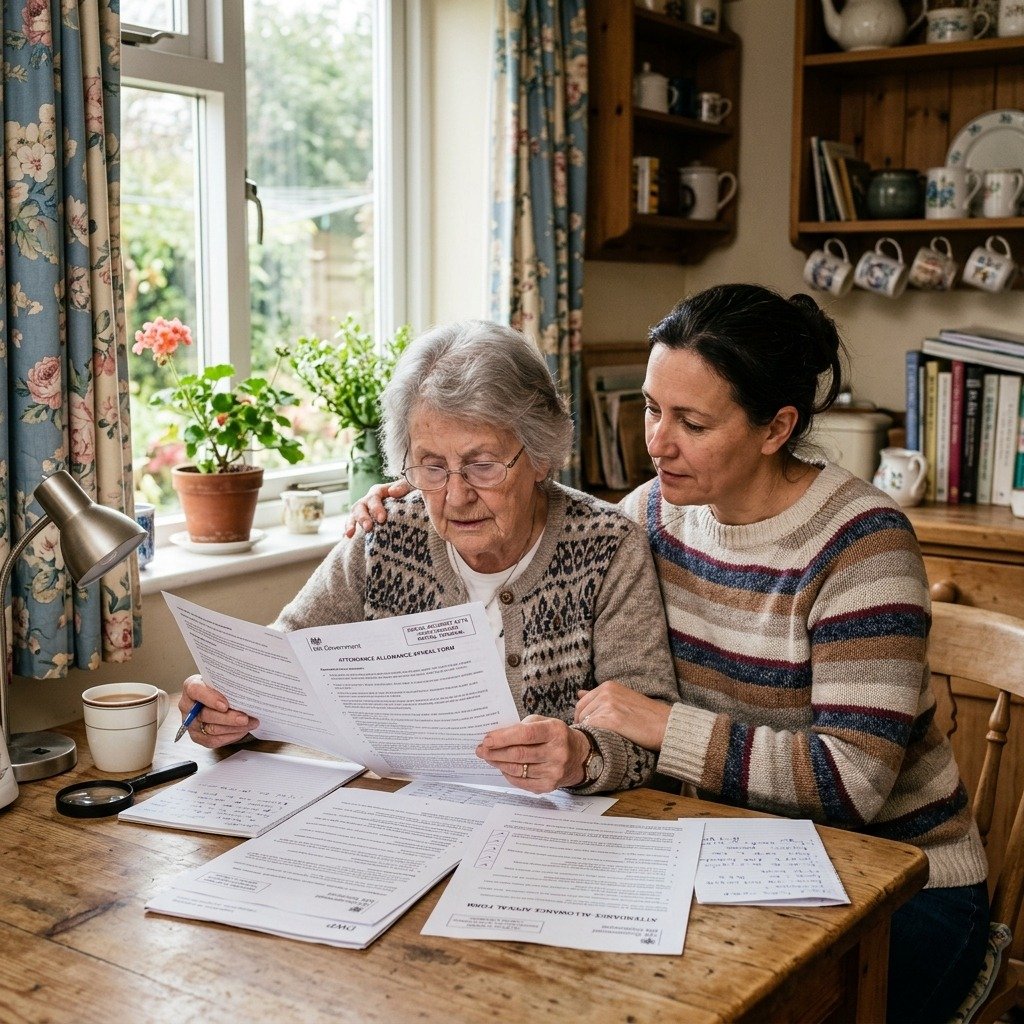
Attendance Allowance Appeal: Tribunal Process, SSCS1 Form and Deadlines
If the Department for Work and Pensions (DWP) refuses your Attendance Allowance claim or awards the wrong rate, you can appeal to the First-tier Tribunal (Social Security and Child Support) after completing mandatory reconsideration. You must submit form SSCS1 within one month of your Mandatory Reconsideration Notice, and an independent panel not the DWP will review your case. Oral hearings succeed far more often than paper-based ones, so attending in person or by video gives you the strongest chance of winning.
Who Actually Hears an Attendance Allowance Appeal?
Attendance Allowance appeals are decided by the Social Security and Child Support Tribunal, part of the First-tier Tribunal and administered by HM Courts and Tribunals Service (HMCTS). This body is legally independent of the DWP the panel hearing your case has no connection to the decision-maker who originally assessed your claim.
Most panels consist of a legally qualified judge and a medical member, often a doctor or other health professional trained to assess functional needs. Because the panel starts fresh and applies its own judgment to the same facts, it frequently reaches a different conclusion than the original DWP decision-maker even without any new evidence being submitted.
There are three possible outcomes: the tribunal can confirm the DWP’s decision, increase your award, or less commonly reduce it. This last possibility is why Citizens Advice recommends getting advice before proceeding, since a tribunal appeal carries some risk as well as opportunity.
How Do You Submit an SSCS1 Form?
The SSCS1 is the official form used to appeal a social security benefits decision, including Attendance Allowance. You can either appeal online through GOV.UK or download and post a paper SSCS1 form.
To submit a valid appeal, you’ll need:
- Your Mandatory Reconsideration Notice the DWP letter confirming they reviewed and maintained their original decision
- A clear, specific explanation of why you disagree with each part of the decision
- Any supporting evidence you want the tribunal to consider
Vague objections rarely help. Instead, work through the decision letter point by point. If the DWP says you don’t need continual supervision, explain concretely what happens without it falls, injuries, or specific incidents rather than making a general statement about your condition.
If submitting the paper form, send it to HMCTS, not the DWP, and use recorded delivery or ask for proof of postage. This protects you if there’s ever a dispute about whether you met the deadline.
What Is the Deadline to Appeal an Attendance Allowance Decision?
You have one month from the date shown on your Mandatory Reconsideration Notice to submit your SSCS1 appeal not one month from when you received the letter. This distinction matters, since postal delays can eat into your window.
If you miss the one-month deadline, you can still submit an appeal up to 13 months after the original decision, provided you explain why it’s late. Acceptable reasons include hospital admission, serious illness, or other circumstances that made it genuinely impossible to act sooner. The tribunal has discretion here, and clear, honest explanations are generally treated more favorably than vague ones.
Should You Choose an Oral Hearing or a Paper Hearing?
This is the single most important decision you’ll make in the appeals process, and the evidence is unambiguous: attending in person gives you a substantially better chance of winning.
According to Law Centre Northern Ireland’s analysis of tribunal statistics for 2024–25, oral hearings across all benefit types succeeded 58.6% of the time, compared with just 27.5% for paper-based decisions made without the claimant present. That’s more than double the success rate simply by choosing to attend.
An oral hearing lets you explain your situation directly, respond to questions, and correct any misunderstanding in real time something a paper file can never do. You can attend by phone, video call, or in person at a tribunal venue, and you’re entitled to bring a representative or supporter with you. A paper hearing, by contrast, is decided solely on the documents in front of the panel, with no opportunity for you to clarify or expand on anything.
Unless there’s a compelling personal reason to avoid attending, requesting an oral hearing is almost always the stronger choice.
What Happens at an Attendance Allowance Tribunal Hearing?
Before the hearing, HMCTS sends you a copy of the DWP’s written response, sometimes called “the bundle.” This includes the evidence the DWP used to make its decision. Read it carefully it tells you exactly what case you need to counter.
On the day, you’ll be introduced to the panel, typically a judge and a medical member. The DWP does not usually send a presenting officer to Attendance Allowance hearings, so in most cases it’s just you (and your representative, if you have one) speaking directly to the panel. Expect questions about your daily life: what help you need, how often, and what happens when that help isn’t available. Be specific and describe your worst days rather than your average ones.
Panels often give a decision verbally on the day, with a full written decision following within a few weeks. If you’re not told the outcome immediately, you’ll receive it by post.
Do You Need Representation at Your Tribunal?
You’re entitled to represent yourself, and many people do. However, you can also bring a family member, friend, or welfare rights adviser they don’t need to be a legal professional. A representative can help prepare your case, explain the paperwork, and speak on your behalf during the hearing.
Free representation is available through Citizens Advice, local disability support services, and in some areas the Free Representation Unit (FRU), a charity providing volunteer advocates for social security tribunals. Given how much a well-prepared submission can influence the outcome, seeking support even informally is worth exploring if you’re unsure how to present your case.
Can You Submit New Evidence Before the Hearing?
Yes. You’re not limited to the evidence you provided during mandatory reconsideration. New medical letters, care records, or witness statements can all strengthen your case, and you can submit them at any point up to the hearing, though it’s best to send anything important at least a week beforehand so the panel has time to review it.
Interestingly, research into comparable disability benefit appeals shows new written evidence isn’t always the deciding factor. Analysis of DWP’s own internal data on overturned Personal Independence Payment decisions found that 59% of successful appeals were won because the tribunal reached a different conclusion on the same facts the DWP already held, and 32% were won through the claimant’s oral evidence at the hearing with new written evidence deciding only a small fraction of cases. The takeaway: turning up and explaining your situation clearly matters just as much as any new document.
How Do Attendance Allowance Tribunal Success Rates Compare?
There’s no publicly published, Attendance-Allowance-specific tribunal success rate, but the closest comparable benefit Disability Living Allowance (DLA), which uses a similar care-needs assessment had a 55% overturn rate in HMCTS’s Q4 2024/25 statistics. Personal Independence Payment (PIP), another disability benefit assessed by a similar tribunal process, ran higher at 66% for the same period.
What’s consistent across all these benefits is the gap between oral and paper hearings. Given AA claimants are typically assessed on very similar grounds to DLA, it’s reasonable to expect a comparable pattern: strong odds at tribunal, especially with an oral hearing, but a meaningfully lower chance if you opt for a paper decision.
What Happens After the Tribunal Decision?
If you win, the DWP must recalculate your award and backdate payments to the date of your original claim or decision. If your appeal fails, you can ask for a “Statement of Reasons” explaining the panel’s reasoning the first step if you want to challenge the decision further.
Further appeal is only possible through the Upper Tribunal, and only on a point of law, not simply because you disagree with the outcome. You have one month from receiving the Statement of Reasons to lodge this appeal, and legal advice is strongly recommended, since Upper Tribunal cases are rare and procedurally demanding for Attendance Allowance claims specifically.
What If You Want to Withdraw Your Appeal?
You can withdraw an appeal at any point before the hearing by notifying HMCTS in writing. This might make sense if your circumstances change, or if a lapsed appeal (where the DWP revises its decision favorably before the hearing takes place) resolves the matter without needing a full tribunal. If you withdraw and later want to challenge a decision again, you’d generally need to start a fresh claim rather than reopen the same appeal.
What Support Is Available If You’re Housebound or Have Additional Needs?
Tribunals can make reasonable adjustments, including home visits for housebound applicants, sign language interpreters, and flexible hearing formats for people with fluctuating conditions. If you have a terminal illness, faster-tracked processes may apply mention this clearly when submitting your SSCS1 form, along with any dates you’re unavailable or specific access requirements, so the tribunal can accommodate them from the outset.
Frequently Asked Questions
How long does an Attendance Allowance tribunal appeal take?
There’s no fixed AA-specific timeline, but appeals across the wider social security tribunal system have averaged around eight months from lodging to hearing in recent HMCTS data, plus the time already spent on mandatory reconsideration. Expect the full process, from original decision to tribunal outcome, to take a year or more in many cases.
Do I have to attend the tribunal in person?
No you can attend by phone, video call, or in person, or ask for a paper hearing instead. However, attending in some form significantly improves your chances of winning compared with a paper-only decision.
Will the DWP be at my hearing?
Usually not for Attendance Allowance cases. Most AA tribunals proceed without a DWP presenting officer, meaning the hearing is primarily a conversation between you and the panel.
Can I bring witnesses or a representative?
Yes. You can bring a family member, friend, or professional adviser to support you, speak on your behalf, or provide additional testimony about your care needs.
What if my condition has gotten worse since I applied?
The tribunal can only consider the situation as it stood at the time of the original decision. If your needs have increased since then, you’ll need to make a new claim, though you can still continue with your existing appeal in parallel.
Do I need a lawyer for a tribunal?
No. Most successful Attendance Allowance appeals proceed without legal representation. Free support from Citizens Advice, welfare rights advisers, or the Free Representation Unit is usually sufficient.
What happens if I lose my tribunal appeal?
You can request a Statement of Reasons and, in limited circumstances, appeal to the Upper Tribunal on a point of law. Otherwise, you can make a fresh Attendance Allowance claim if your care needs have since changed.