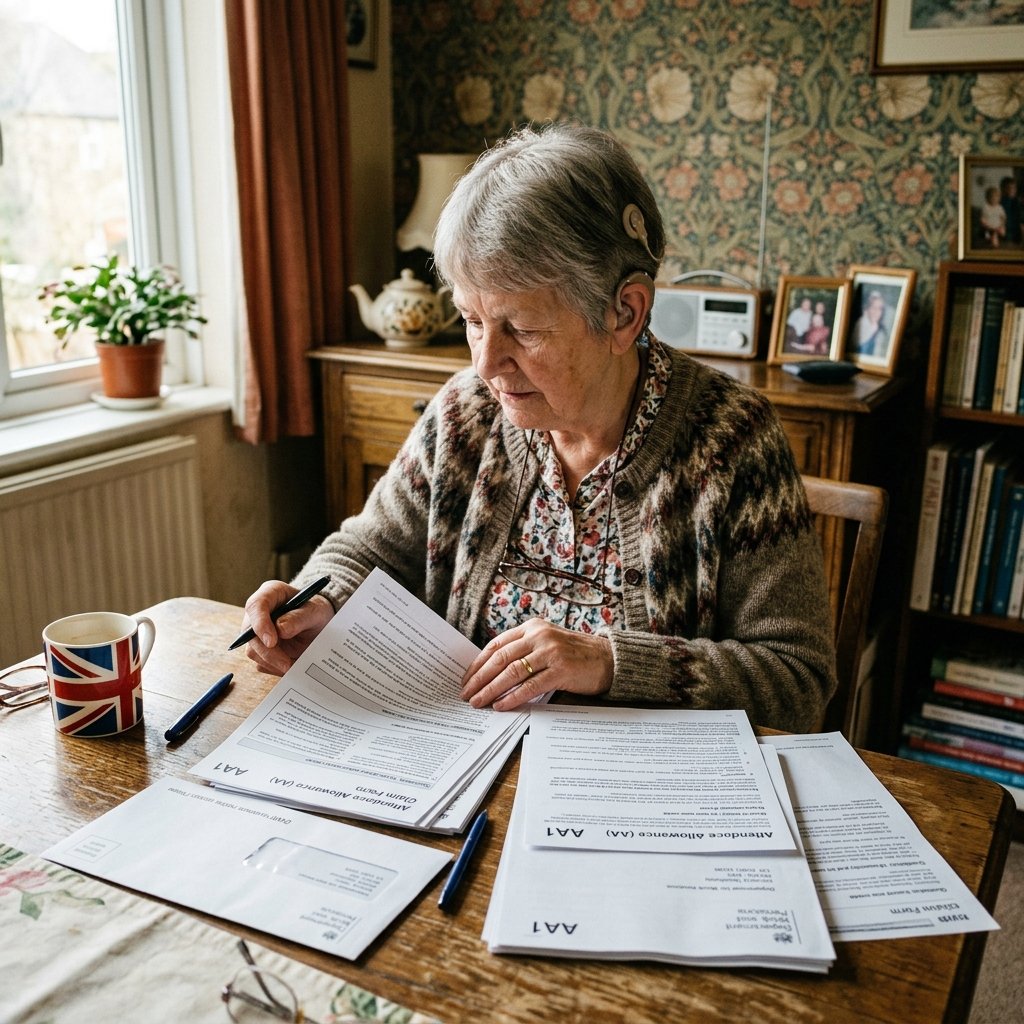
Attendance Allowance Deaf: Hearing Loss, Fees and Claim Rules
Deaf people and those with significant hearing loss can claim Attendance Allowance via the safety supervision route not just personal care. The strongest claims combine severe or profound hearing loss (70 dB+) with night-time supervision needs, such as inability to respond to a smoke alarm. From April 2026, AA pays £76.70 (lower rate) or £114.60 (higher rate) per week.
Why Hearing Loss Is Harder to Claim Than Sight Loss
Attendance Allowance claims built around hearing loss are consistently undervalued and frequently underpaid because most claimants and even some advisers frame them incorrectly from the start.
DWP Interpretation of “Personal Care” and Hearing
The AA1 form focuses heavily on personal care: washing, dressing, eating, toileting. Hearing loss does not obviously disrupt most of those tasks. As a result, many deaf claimants understate their needs on the form, or write nothing at all in sections that appear irrelevant. That is a costly mistake.
Personal care under DWP rules extends to communication, understanding medical instructions, and safely navigating daily life. If hearing loss prevents a person from understanding what a doctor says, or from following medication instructions given verbally, those are legitimate care needs even if the person can still dress themselves independently.
The Safety Supervision Route as Primary Case
The stronger route for most deaf claimants is safety supervision: the need for another person to be present or available to prevent danger to the claimant or others. DWP legislation explicitly covers this. A person who cannot hear a smoke alarm, a shouted warning, or an emergency announcement is at risk and that risk builds the supervision case.
This is why hearing loss claims succeed most often when the applicant stops trying to fit into the personal care mould and instead documents the genuine hazards of living in a hearing world without functional hearing.
Combined Conditions as the Strongest Route
The very strongest claims combine hearing loss with another condition vestibular disorder, dementia, vision impairment, or mobility problems. Each condition adds weight to both the care and supervision cases. If you have more than one condition alongside hearing loss, every interaction between them should be documented on the form.
Late-Onset Profound Deafness vs. Congenital Deafness
Someone who has been deaf from birth has adapted over decades. They may have robust BSL skills, established support networks, and years of practice navigating risk. Their needs are real but may be less acute in some domains than someone who loses hearing suddenly in their 70s, with no adaptive strategies in place and no established community support.
Late-onset profound deafness often produces greater psychological vulnerability, communication breakdown with family, and a loss of safety awareness that the claimant has not yet compensated for. DWP decision-makers should be told which situation applies.
Hearing Loss Categories and AA Implications
|
Hearing Loss Level |
dB Range |
Likely Impact |
Typical AA Outcome |
|
Mild |
25–40 dB |
Difficulty in noisy environments |
Usually not eligible |
|
Moderate |
40–70 dB |
Struggles with speech, misses doorbells/alarms |
Variable depends on overall picture |
|
Severe |
70–95 dB |
Cannot use a phone, significant safety risk |
Care case possible; lower rate likely |
|
Profound |
>95 dB |
Functionally deaf; major supervision needs |
Strongest case; higher rate achievable |
Mild Hearing Loss (25–40 dB) Usually Not Eligible
At this level, hearing aids typically restore near-normal function. Eligibility is unlikely unless significant concurrent conditions exist.
Moderate (40–70 dB) Variable
Claims at this level depend heavily on other factors: cognitive decline, balance disorders, living alone, or inability to use assistive technology effectively. Don’t assume moderate hearing loss automatically disqualifies document the full picture.
Severe (70–95 dB) Care Case Possible
At this level, even with hearing aids, significant functional limitation remains. The person cannot reliably use a standard telephone, will miss many environmental sounds, and faces genuine safety risks. A well-evidenced claim at this level should succeed at lower rate, and potentially higher rate if night needs are documented.
Profound (>95 dB) Strongest Case
Functionally deaf. Safety supervision needs across day and night are substantial. The higher rate (day and night needs combined) is achievable with strong evidence.
The Safety Supervision Case for Deafness
Fire Alarm and Smoke Detector Response
This is the single strongest argument for overnight AA. A profoundly deaf person who does not use a vibrating alarm or has one that malfunctions cannot respond to a standard smoke alarm. Without someone present and awake who can alert them, the risk is severe.
Doorbell and Visitor Identification
Missing a doorbell is not just inconvenient it can mean missing a district nurse, failing to receive medication deliveries, or being unable to identify who is at the door (a safety issue for those living alone).
Boiling Kettle and Kitchen Audio Cues
A deaf person cannot hear a boiling kettle, a hissing gas ring, or a microwave alarm. In the kitchen, missed audio cues can result in burns, fire, or gas-related risk. This feeds directly into the supervision case.
Traffic and Outdoor Risk
Outdoor movement carries genuine risk for people who cannot hear approaching vehicles, cyclists, or warnings from other pedestrians. For those in flats or homes near busy roads, even indoor windows may be insufficient.
Response to Emergency Services and 999 Access
A person who cannot use a standard phone to call 999 faces a genuine safety gap. Text-based emergency access (the 999 SMS service, registered in advance) or the Emergency SMS system exists but knowledge of and access to these systems varies, and they add friction in an emergency.
Someone Else’s Shouted Warnings Unheard
A partner shouting that the hob is on, that a visitor is at the door, or that there’s a flood in the bathroom none of these warnings reach a profoundly deaf person. The supervision case documents how the absence of a hearing person creates risk.
Overnight Fire and Medical Emergency Response
If a partner suffers a heart attack at 3am and cannot reach a phone, a profoundly deaf person sleeping without hearing aids will not hear shouted calls for help. This is a powerful higher-rate argument.
Communication and Personal Care
Medical Appointment Support
Many deaf people need a BSL interpreter or lipspeaking support for GP and hospital appointments. Without that, medication instructions, diagnoses, and treatment plans may be misunderstood. This is a personal care need under DWP rules.
Medication Instructions and Understanding
Verbal instructions from pharmacists or nurses may be missed or misheard. If a person relies on someone to relay or confirm medication guidance, that dependency should be described explicitly on the AA1 form.
Reading GP Correspondence
Severe communication anxiety around written medical correspondence particularly for those whose first language is BSL rather than English may mean that a person requires help interpreting letters from their GP or hospital.
Emergency Service Communication
Beyond 999 access, interactions with paramedics, police, or fire services in an emergency are significantly compromised without hearing. The need for another person to communicate on the claimant’s behalf is legitimate and documentable.
Assistive Technology as Evidence Not a Disqualifier
Vibrating Alarm Clocks Night Care May Still Qualify
DWP decision-makers sometimes assume that assistive technology resolves the need. It does not. A vibrating alarm clock addresses wake-up time, not a fire alarm or a partner’s midnight medical emergency. Describe what the technology does and does not cover.
Flashing Doorbells Still Need to See Them
A flashing doorbell only works if the person is in the same room and facing it. It does not eliminate the supervision need.
Hearing Aids and Cochlear Implants
Hearing aids are removed at night. They do not restore normal hearing. They may malfunction. They require maintenance. None of these facts disqualify a claim they support it. Document hearing aid limitations explicitly.
Loop Systems
Loop systems (hearing loops) are venue-specific and do not transfer to home environments. Noting the absence of a home loop system and its effect on telephone or television use can support the communication case.
Cochlear Implants and AA
A cochlear implant is not a cure. People with cochlear implants still face significant limitations that support an AA claim.
Post-Surgery Rehabilitation Needs
The months following implantation involve intensive auditory rehabilitation frequent appointments, exercises, and speech processor tuning. This is a period of heightened need.
Speech Processor Maintenance and Battery Management
The external speech processor requires daily battery management, cleaning, and regular tuning by an audiologist. If the processor fails, the person reverts to profound deafness immediately.
Removal at Night Supervision Case
Cochlear implant users remove their speech processor at night. During sleep, they are profoundly deaf. The overnight supervision case applies in full.
Environmental Listening Still Limited
Background noise, distance, and poor acoustics compromise even the best cochlear implant outcomes. A claimant should not assume their implant disqualifies them it changes, but does not eliminate, the supervision and care needs.
Combined Deafblindness (Dual Sensory Impairment)
Dual sensory impairment simultaneous hearing and vision loss dramatically escalates care needs and produces the strongest possible AA case. Usher syndrome, age-related macular degeneration combined with presbycusis, and other combinations are common in older claimants.
DeafBlind UK can provide assessments and letters of support that carry significant weight with DWP. A one-to-one communicator-guide need is a clear, articulable care requirement that maps directly to the higher AA rate.
Age-Related Hearing Loss (Presbycusis) Specifically
Presbycusis is the most common cause of hearing loss in over-66s and therefore the most common hearing-related AA claim. Its progressive nature means family communication gradually breaks down, social isolation increases, and mental health often deteriorates in ways that compound the care needs.
Central auditory processing decline difficulty making sense of sounds even when they are audible is distinct from peripheral hearing loss but equally significant for AA purposes. If you also have cognitive decline or dementia alongside hearing loss, see our dedicated dementia AA page for how those conditions interact.
Tinnitus, Ménière’s Disease, and Balance
Severe Tinnitus and Sleep Disruption
Tinnitus alone rarely qualifies for AA. However, severe tinnitus that prevents sleep and requires overnight supervision or prompting does contribute to a night-care case, particularly when combined with hearing loss.
Ménière’s Disease Attacks and Mobility Supervision
Ménière’s disease causes sudden episodes of severe vertigo, nausea, and disorientation. During an attack, the person cannot safely walk unassisted. If attacks occur unpredictably including at night the supervision case is strong. Document frequency, duration, and severity of attacks.
BPPV Falls Risk
Benign paroxysmal positional vertigo (BPPV) causes sudden, brief dizziness triggered by head movement. The falls risk, particularly on stairs or in the bathroom, requires supervision and feeds the safety case.
Bilateral Vestibular Loss
Damage to both vestibular systems results in chronic instability. Walking in the dark including to the bathroom at night carries genuine fall risk. Night supervision needs are clear and documentable.
Weak vs Strong Deaf AA1 Wording 10 Examples
1. Smoke alarm (night)
Weak: “I have hearing loss so I might not hear the alarm.”
Strong: “Due to profound hearing loss in both ears (confirmed by audiogram, copy enclosed), I do not wear hearing aids at night and cannot hear a standard smoke alarm. Without someone awake and present who can physically alert me, I have no means of responding to a fire during the night.”
2. Emergency phone call
Weak: “I find phone calls difficult.”
Strong: “I cannot use a standard telephone. I am unable to call 999 in an emergency. I rely on someone else to make emergency calls on my behalf or must use the pre-registered 999 SMS service, which requires time and device availability not always possible in a crisis.”
3. Doorbell response
Weak: “I don’t always hear the doorbell.”
Strong: “I routinely miss the doorbell, including district nurse visits and medication deliveries. My flashing doorbell alert only works if I am in the room facing it. I have missed two community nurse appointments in the last three months as a result.”
4. Kitchen safety cues
Weak: “I might leave the kettle on.”
Strong: “I cannot hear a boiling kettle, a hissing gas ring, or the microwave alarm. On three occasions in the past month I have returned to the kitchen to find the hob still on because I did not hear the food burning. I need someone present when I cook.”
5. Cooker safety
Weak: “Cooking can be dangerous for me.”
Strong: “I am unable to hear gas escaping or the click of an unlit burner. I need verbal (or physical) prompting from another person before and after using the hob to confirm it is safely off.”
6. Medical appointment communication
Weak: “I struggle in appointments.”
Strong: “I require a BSL interpreter or lipspeaker for every GP and hospital appointment. Without this support, I cannot understand diagnoses, treatment options, or medication changes. Arranging and attending with an interpreter takes significant additional time and planning.”
7. Understanding correspondence
Weak: “Medical letters can be confusing.”
Strong: “My first language is BSL. Reading and interpreting complex written correspondence from the NHS causes significant cognitive fatigue and anxiety. I rely on a family member to read and explain letters to me, which may take multiple sessions.”
8. Balance support with Ménière’s
Weak: “I sometimes feel dizzy.”
Strong: “I experience sudden vertigo attacks due to Ménière’s disease, typically lasting 20–40 minutes, occurring two to three times per week without warning. During an attack I cannot stand unassisted and have fallen twice. I require someone present who can help me to a safe position.”
9. Mobility indoors with tinnitus
Weak: “My tinnitus affects my sleep.”
Strong: “Severe bilateral tinnitus prevents me from sleeping before 2–3am most nights. Exhaustion causes significant daytime unsteadiness, and I require prompting and physical assistance when moving between rooms to prevent falls.”
10. Medication instructions
Weak: “I sometimes misunderstand instructions.”
Strong: “I cannot reliably understand verbal instructions from pharmacists. On two recent occasions I took the incorrect dose of a prescribed medication because I misheard the pharmacist’s instructions. I now require someone to accompany me and confirm all dispensing instructions in writing.”
The Night Care Case for Deafness
Securing the higher rate requires documenting needs during both day and night. For deaf claimants, the night case often rests on the following arguments.
Fire Alarm Response Overnight
Already covered above this is the clearest night-care argument for profound deafness. Describe the specific alarm setup (or absence of one), whether a vibrating alarm covers this, and its limitations.
Medical Emergency Response
A partner’s overnight medical emergency cardiac arrest, stroke, fall is wholly inaudible to a profoundly deaf person sleeping without hearing aids. They cannot respond, alert emergency services, or provide assistance.
Vibrating Pillow Alarms Supplementary Evidence
A vibrating alarm clock or pillow shaker addresses wake-up time only. It does not address fire, partner medical emergency, or home intrusion. Note what it covers and what it does not.
Home Invasion Response
A profoundly deaf person cannot hear sounds of a break-in a broken window, a forced door, or movement in the house. This is a safety supervision need, particularly for those living alone.
Evidence to Strengthen a Hearing Loss Claim
The stronger the evidence, the more persuasive the claim. Attach copies where possible and reference them in the form.
- Audiology reports and audiograms these are essential. Request a copy from your audiology clinic.
- ENT consultant letters confirm diagnosis, severity, and prognosis.
- Cochlear implant team reports document the limitations of implant function.
- Hearing therapist reports especially where coping strategies have been discussed and their limitations noted.
- DeafBlind UK assessment for dual sensory impairment claims.
- Occupational therapist safety assessment documents specific home risks.
- Fire service Home Safety Check report councils and fire services offer free home safety visits; a written report from this visit is powerful AA evidence.
Hearing Loss-Specific Pitfalls
Assuming hearing aids solve everything. They don’t. They are removed at night, they malfunction, they don’t restore normal hearing. Say this clearly on the form.
Failing to frame the safety supervision case. Many claimants describe communication difficulties without linking them to safety risk. DWP needs to understand why the communication difficulty creates a hazard.
Missing the tinnitus and dizziness component. If you also have tinnitus or vestibular problems, these should appear explicitly on the form not buried in an afterthought.
Downplaying communication access needs. “I find it hard to follow conversations” is weaker than a specific example of a missed medical instruction that caused a concrete problem.
Not mentioning night supervision. The higher rate is significantly more valuable. Many claimants don’t even attempt the night-care argument. If it applies, make it.
Frequently Asked Questions
Does moderate hearing loss (40–70 dB) qualify for Attendance Allowance?
It can, but the outcome depends on the full picture. Moderate hearing loss that combines with balance problems, cognitive decline, or significant safety risk can support a claim. Hearing loss alone at the moderate level, where hearing aids provide adequate compensation, is unlikely to succeed.
Do I need to wear hearing aids to claim?
No. You do not need to wear hearing aids. But if you have been offered hearing aids and declined them without good reason, a decision-maker may take that into account. If you wear aids, document what they do and do not compensate for.
What if I have a cochlear implant does that disqualify me?
No. A cochlear implant does not disqualify a claim. Implant users remove their processor at night (reverting to profound deafness), require ongoing rehabilitation and maintenance, and still face significant limitations in noisy or acoustically difficult environments. Document all of these.
Does tinnitus alone qualify for Attendance Allowance?
Rarely. Tinnitus alone, without functional hearing loss or significant sleep and balance disruption, does not typically qualify. Where tinnitus causes severe sleep deprivation leading to daytime risk, or combines with balance problems, it contributes to a claim.
Can I claim Attendance Allowance for Ménière’s disease?
Yes, if attacks are severe and frequent enough to create a genuine supervision need. Unpredictable vertigo attacks requiring physical assistance, combined with the hearing loss component of Ménière’s, can build a strong claim at either rate.
Do I need to be a BSL user to claim?
No. BSL use is not a condition of eligibility and has no bearing on the claim. Non-BSL users and BSL users with equivalent degrees of hearing loss have the same eligibility.
What if my hearing loss was sudden am I eligible immediately?
You must have needed the relevant care or supervision for at least six months before claiming (unless you are terminally ill). If your hearing loss is recent, the six-month qualifying period applies. You can submit the claim before six months have elapsed as long as you have had the need for six months by the time a decision is made.
Can I claim Attendance Allowance for age-related hearing loss?
Yes. Presbycusis is a physical sensory disability and is explicitly covered by AA eligibility rules. The claim will be assessed on the functional impact how the hearing loss affects your ability to live safely not the cause of the loss.