Attendance Allowance Benefit Increase: New Rates and CPI 2026
Attendance Allowance rises by 3.8% from 7 April 2026, in line with the September 2025 Consumer Prices Index (CPI) figure. The lower rate increases from £73.90 to £76.70 a week, and the higher rate rises from £110.40 to £114.60 a week. That’s an extra £145.60 a year for lower rate claimants and £218.40 a year for those on the higher rate. No action is needed the Department for Work and Pensions (DWP) applies the new rate automatically.
How does the annual Attendance Allowance increase actually work?
Attendance Allowance is uprated once a year, and the calculation isn’t arbitrary. The DWP links the increase to the Consumer Prices Index (CPI) specifically, the CPI figure published for September of the previous year.
Here’s the sequence:
- September CPI is published in October. This figure becomes the reference point for the following April’s benefit rates.
- The Treasury announces the new rates in November, usually through a written ministerial statement from the Secretary of State for Work and Pensions.
- The DWP formally confirms the rates in a policy paper for 2026/27, this was published on 27 November 2025 and updated in February 2026 once the figures were finalized.
- The new rate takes effect from the first Monday of the new tax year, typically around 6–7 April.
Why September specifically? It gives the government enough lead time to build the figure into the Budget process, update DWP payment systems, and issue uprating letters before the new tax year begins.
What’s the 2026/27 Attendance Allowance increase, exactly?
The confirmed increase for 2026/27 is 3.8%, matching the September 2025 CPI rate. This is the figure that’s driving what many are calling the “DWP pensioner boost” across UK media coverage this winter.
Here’s the breakdown:
|
Rate |
2025/26 |
2026/27 |
Weekly increase |
Annual increase |
|
Lower rate |
£73.90 |
£76.70 |
+£2.80 |
+£145.60 |
|
Higher rate |
£110.40 |
£114.60 |
+£4.20 |
+£218.40 |
These rates apply from 7 April 2026, the first Monday of the 2026/27 tax year, through to 6 April 2027. According to Parliament’s Main Estimate documentation, uprating disability benefits by 3.8% in 2026/27 accounts for £1,765 million of the overall spending increase across the affected benefit lines.
How has Attendance Allowance changed over the past decade?
Uprating isn’t consistent year to year it moves with inflation, which means some years bring modest increases and others bring substantial ones.
|
Tax year |
Lower rate |
Higher rate |
Increase |
|
2026/27 |
£76.70 |
£114.60 |
3.8% |
|
2025/26 |
£73.90 |
£110.40 |
1.7% |
|
2024/25 |
£72.65 |
£108.55 |
6.7% |
|
2023/24 |
~£68.10 |
~£101.75 |
10.1% |
|
2020/21 |
1.7% |
The standout year is 2023/24, when soaring inflation pushed the uprating figure to 10.1% the largest single-year increase in recent memory. By contrast, 2020/21 and 2025/26 both saw a more modest 1.7% rise, reflecting calmer inflation conditions in the months that set those rates. Over a run of years combining low-inflation and high-inflation periods, the cumulative effect still meaningfully outpaces a frozen rate, even if individual years feel underwhelming.
When do the new rates actually appear in my payments?
Attendance Allowance is paid every four weeks, not monthly, so your first payment reflecting the new rate depends on where your payment cycle falls relative to 7 April 2026.
If your payment date lands on or after the effective date, you’ll see the full new rate. If your four-week cycle straddles the change-over, the DWP calculates a blended payment covering the days at the old rate and the days at the new rate you don’t need to do anything to trigger this; it’s handled automatically by their payment systems.
Most claimants notice the change reflected in their next scheduled payment after 7 April. If several weeks pass and your payment amount hasn’t changed, that’s worth following up on (more on that below).
Why doesn’t Attendance Allowance get the triple lock like the State Pension?
This is one of the most common points of confusion, and it’s a fair one to raise. The State Pension is protected by the “triple lock,” which guarantees an increase each year of whichever is highest: 2.5%, average earnings growth, or CPI inflation. For 2026, the triple lock is delivering a 4.8% State Pension increase, driven by the earnings figure.
Attendance Allowance, along with most other disability benefits, is uprated by CPI only there’s no earnings or 2.5% floor underneath it. In practice, this means that in low-inflation years, Attendance Allowance can rise more slowly than the State Pension, even though both are aimed at supporting older people. This distinction has drawn criticism from disability charities and some MPs, who argue that care costs often driven by wages in the care sector can outpace general inflation, leaving the CPI-linked rate lagging behind actual need. That said, the legal requirement to review these rates annually is well established, so a freeze isn’t on the table regardless of the political debate around methodology.
Does the CPI link make a real difference compared to the old RPI system?
Yes, and it’s worth understanding why. Before 2010, most benefits Attendance Allowance included were uprated using the Retail Prices Index (RPI), which historically tends to run higher than CPI because it includes different housing cost calculations, such as mortgage interest payments. The switch to CPI was framed as a technical adjustment, but the cumulative effect over 15 years has been that benefits have grown somewhat more slowly than they would have under the old system. This is a large part of why disability and pensioner advocacy groups periodically call for a return to RPI, or a move to CPIH (which factors in owner-occupied housing costs), though no such change has been confirmed for Attendance Allowance uprating going forward.
Does the increase affect Pension Credit, Housing Benefit, or Council Tax Reduction?
If you receive Attendance Allowance, it can increase your entitlement to several means-tested benefits this is sometimes called the “passporting” effect. When your Attendance Allowance goes up, it’s worth checking whether:
- Your Pension Credit award changes, since Attendance Allowance can trigger additional premiums
- Your Housing Benefit entitlement is affected, particularly if you’re assessed for a disability premium
- Your Council Tax Reduction threshold shifts as a result
Not all passported benefits uprate on the same schedule or by the same percentage, so it’s worth reviewing your full benefits picture each April rather than assuming everything moves in lockstep.
Will I get a letter about the increase, and do I need to do anything?
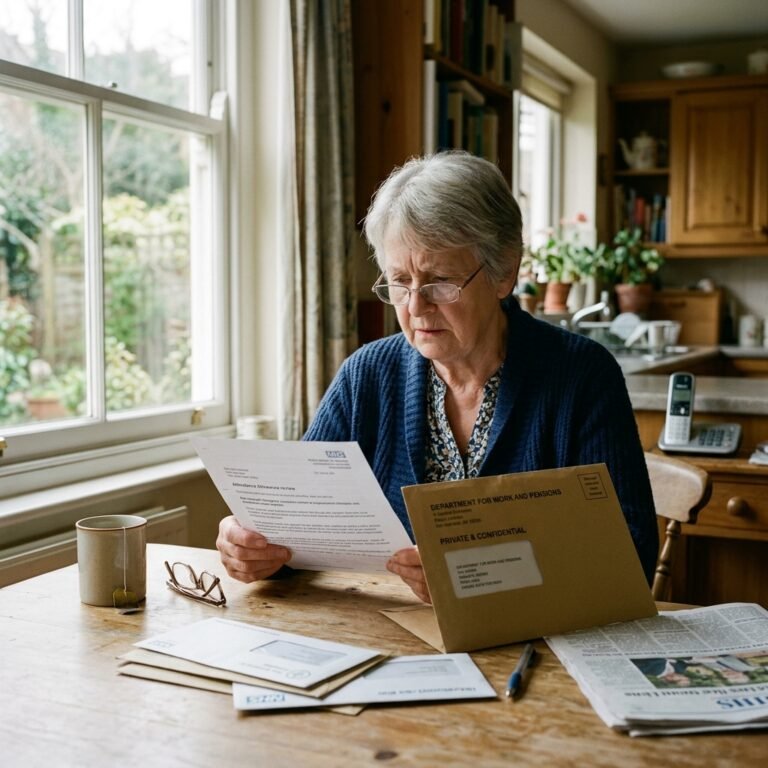
Yes. The DWP sends an annual uprating letter to every Attendance Allowance claimant, typically arriving in March, ahead of the April change. This letter confirms your new weekly rate and the date it takes effect.
You don’t need to take any action to receive the increase it’s applied automatically. Keep the letter for your records, though, since it can serve as proof of your current award amount if you need to provide evidence to other agencies, such as your local council for Council Tax Reduction purposes.
What should I do if my payment hasn’t gone up?
If it’s past 7 April 2026 and your payment still reflects the old rate, take these steps:
- Compare your rate against the confirmed GOV.UK figures £76.70 (lower) or £114.60 (higher).
- Check your uprating letter to confirm what rate the DWP says you should be receiving.
- Call the Attendance Allowance helpline on 0800 731 0122 (Monday to Friday, 8am to 6pm) if there’s a discrepancy.
- Ask for a written explanation if the issue isn’t resolved on the call, so you have a record for any follow-up.
What’s likely to happen to Attendance Allowance rates in 2027/28?
The 2027/28 rate will be set by the September 2026 CPI figure, published in October 2026, with the Treasury’s announcement expected around November 2026 and formal DWP confirmation typically following in the new year. As of now, no reliable figure exists for that CPI reading, so any specific percentage floating around is speculation rather than a forecast worth planning around. The most useful thing to do is watch for the DWP’s benefit and pension rates policy paper each autumn, which is the authoritative source once published.
Frequently Asked Questions
When do Attendance Allowance rates go up each year?
Rates change annually on the first Monday of the new tax year, which for 2026/27 is 7 April 2026.
How much did Attendance Allowance increase this year?
Attendance Allowance increased by 3.8% for 2026/27, based on the September 2025 CPI figure.
What is the 2026 Attendance Allowance rate?
From April 2026, the lower rate is £76.70 a week and the higher rate is £114.60 a week.
What is the “DWP pensioner boost” people are talking about?
This refers to the annual CPI-linked uprating of pensioner and disability benefits, including Attendance Allowance, which rose 3.8% for 2026/27.
When will the 2027 Attendance Allowance rates be announced?
Expect a Treasury announcement around November 2026, based on the September 2026 CPI figure, with formal DWP confirmation following in early 2027.
Do I need to do anything when Attendance Allowance rates go up?
No. The increase is applied automatically to your existing award no reapplication or notification from you is required.
How is the Attendance Allowance increase calculated?
The DWP applies the percentage change in the Consumer Prices Index for September of the previous year to the current weekly rates.
Will Attendance Allowance keep rising in line with inflation next year?
Attendance Allowance is legally required to be reviewed annually against CPI, so it will be uprated again in 2027/28, though the exact percentage depends on inflation data not yet published.