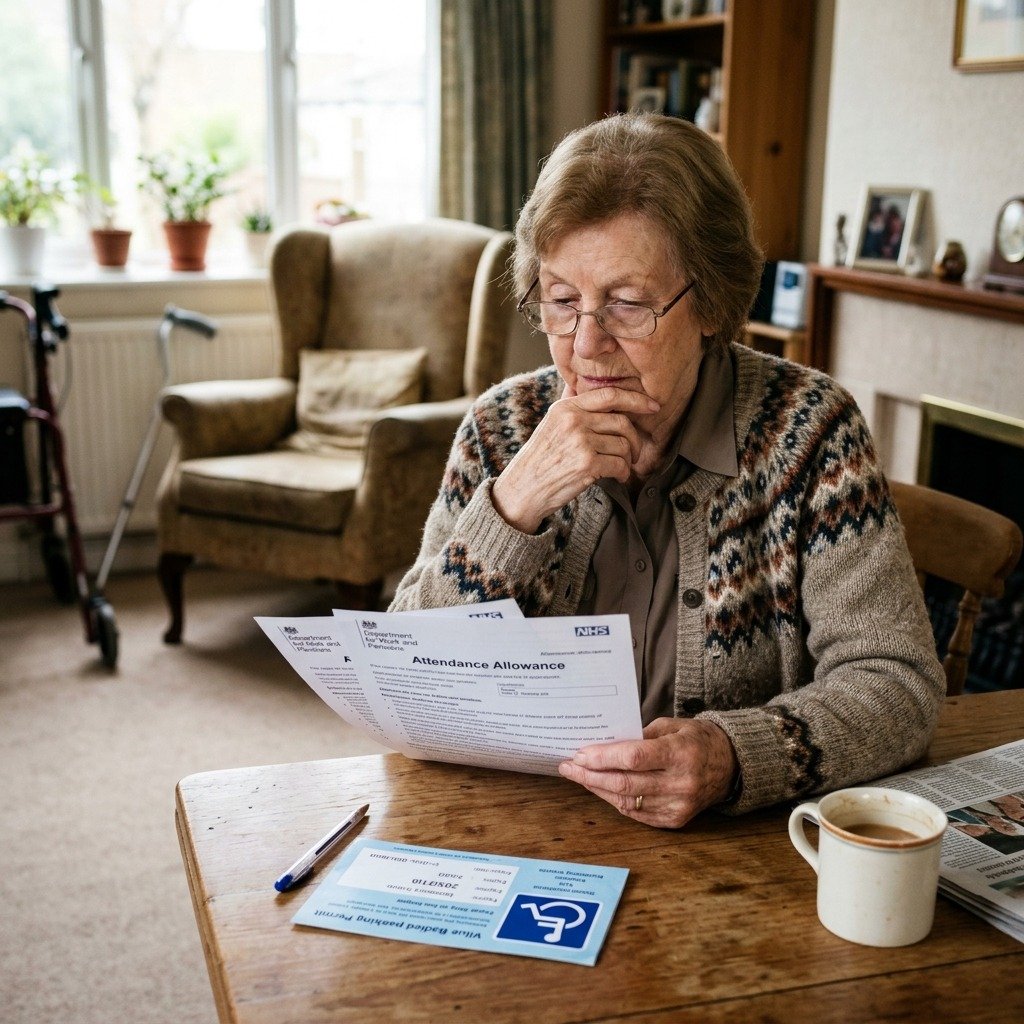
Attendance Allowance and Blue Badge: Eligibility, Evidence & Application
Attendance Allowance does not automatically qualify you for a Blue Badge. Unlike PIP claimants who score 8+ points on the “moving around” descriptor, Attendance Allowance has no mobility component built into it. AA claimants must apply through the discretionary assessment route, where the local council independently assesses your walking ability, falls risk, or non-visible disability impact regardless of your AA award rate.
Why Attendance Allowance Doesn’t Automatically Qualify for a Blue Badge
Blue Badge is a mobility-based scheme, not a care-based one
The Blue Badge scheme exists to help people who struggle to walk or who pose a risk to themselves or others while out and about. Attendance Allowance, by contrast, exists to help with personal care needs supervision, help with washing, dressing, or staying safe at night. These are two different assessments measuring two different things, which is why an AA award, even at the higher rate, doesn’t carry automatic weight with a council’s parking team.
AA has no mobility component
DLA and PIP both include a distinct mobility component that assesses walking distance, speed, and safety. Attendance Allowance was never designed with this in mind it’s a single-rate structure covering day needs, night needs, or both. Because there’s no mobility scoring built into the AA1 claim form, a council reviewing a Blue Badge application can’t simply “read across” from your AA decision letter.
The automatic (Group 1) qualifying benefits
Councils grant automatic Blue Badge eligibility to people who:
- Receive the higher rate mobility component of Disability Living Allowance
- Score 8+ points on the “moving around” activity of a PIP assessment
- Score 10 points under Descriptor E of the “planning and following journeys” PIP activity (overwhelming psychological distress that prevents journeys)
- Are registered blind
- Receive War Pensioners’ Mobility Supplement
- Received a lump sum under tariffs 1–8 of the Armed Forces Compensation Scheme, with certified permanent and substantial disability
Attendance Allowance is notably absent from this list, no matter which rate you receive.
What “discretionary assessment” means in practice
If you don’t fall into Group 1, the council looks at your individual circumstances instead of your benefit type. This means providing evidence about how far you can walk, how it makes you feel, whether you’re at risk of harm, or how a non-visible condition affects your ability to go on a journey safely.
Local authorities make the final call
Each council administers its own Blue Badge assessments, sometimes using an independent occupational therapist or physiotherapist. This means outcomes can vary slightly between councils even when applicants present similar evidence, so it’s worth tailoring your application to what your specific local authority asks for.
The Two Blue Badge Qualifying Routes
Group 1: Automatic qualification
As outlined above, Group 1 applicants provide their benefit decision letter and receive their badge with minimal further assessment.
Group 2: Discretionary assessment
Group 2 covers everyone else including AA claimants. You’ll need to complete an additional section of the application explaining your walking difficulty, arm disability, or non-visible condition, backed by supporting evidence.
Which route applies to AA claimants
Because AA doesn’t appear on the automatic list, every Attendance Allowance claimant applying for a Blue Badge goes through Group 2, regardless of whether they receive the lower or higher rate.
Why the two routes exist
Group 1 exists to fast-track people whose mobility need is already independently verified through another government assessment. Group 2 exists because plenty of people including many older adults on Attendance Allowance have genuine walking difficulties that simply haven’t been captured by a mobility-specific benefit.
The Discretionary Assessment Criteria
The “considerable difficulty” test
Assessors look for whether you experience considerable difficulty walking this might include pain, breathlessness, or needing frequent rests over a fairly short distance.
The “very considerable difficulty” test
Some councils apply a higher bar of “very considerable difficulty,” which may include very considerable psychological distress associated with walking or leaving the house, not just physical strain.
Measuring walking distance in practical terms
Citizens Advice recommends thinking in terms of parked buses (roughly 11 metres each) rather than guessing in metres. If you can only manage half a bus length before needing to stop, that’s about 5 metres write this down precisely, along with how many steps you can manage unaided.
Describing pain and breathlessness
Don’t just say walking is “difficult.” Describe what actually happens: do you need to stop and lean on something, does your breathing become laboured, do you experience joint or muscle pain that forces you to sit down?
Falls risk during walking
If you’re unsteady, have had falls, or use a frame or stick, note the frequency of falls and any near-misses. This is often more persuasive to assessors than a general statement about “poor balance.”
Non-visible disability provisions (since 2019)
Since August 2019, the scheme has also covered non-visible disabilities conditions like dementia, autism, or severe anxiety that affect a person’s ability to make a journey safely, even if their physical walking ability isn’t limited.
Building a Strong Discretionary Application
A GP or consultant letter specifying distance and difficulty
Generic letters confirming a diagnosis rarely help. Ask your GP or consultant to state, if possible, an estimated safe walking distance and specific symptoms that limit it.
Physiotherapy assessment reports
If you’re under a physiotherapist, their notes on gait, endurance, and mobility aids used can carry real weight, since they often include objective measurements.
Falls clinic records
If you’ve been referred to a falls clinic, include any records these provide independently documented evidence of risk that supports a discretionary award.
Occupational therapy home assessments
An OT report describing how you manage steps, transfers, or outdoor mobility around your home can reinforce a picture of overall walking difficulty.
A detailed personal impact statement
Write in your own words what a short walk looks like for you the outdoor stairs to your car, the effort involved reaching the shop, or the anxiety you feel once outside. Specific, honest detail is far more persuasive than broad claims like “I struggle to walk.”
How an AA award supports but doesn’t guarantee your claim
Receiving Attendance Allowance, especially at the higher rate, can be useful supporting evidence because it shows an existing DWP-recognised care need. Attach your AA decision letter alongside your medical evidence, but don’t rely on it alone the council still needs its own mobility-specific evidence.
Non-Visible Disability Route (Post-2019)
Cognitive impairment and Blue Badge applications
For conditions affecting memory, judgement, or awareness of danger, describe specific incidents getting lost on a familiar route, freezing at road crossings, or becoming disoriented in busy car parks.
Dementia and wandering risk
If wandering or getting lost is a concern, say so directly and give examples. Assessors are specifically looking for risk of harm to the applicant or to others, which dementia-related wandering clearly demonstrates.
Autism and sensory overload
Describe concrete sensory triggers crowded car parks, traffic noise, or unpredictable environments and what happens when overload occurs (shutdown, meltdown, or attempts to run from the situation).
Mental health conditions and panic-related claims
For panic attacks or severe anxiety, explain what prevents you from making a journey: is it fear of open spaces, fear of collapsing in public, or an inability to leave the house at all on bad days? Note the frequency and severity.
How to describe non-visible impact effectively
Avoid vague phrases like “I get anxious.” Instead: “I have had three panic attacks in supermarket car parks in the last six months, requiring me to return home immediately.” Specificity is what separates a strong non-visible disability application from a weak one.
How to Apply for a Blue Badge
Applying via GOV.UK or your local council
Most people apply online through GOV.UK, though some councils still accept paper forms.
Application fees
Councils in England can charge up to £10; Scotland charges £20; Wales currently doesn’t charge at all.
Documents you’ll need
Have ready: your National Insurance number, proof of identity and address, a recent digital photo, and if applying via Group 2 as much medical evidence as you can gather.
Processing times
Applications can take up to 12 weeks, sometimes longer, particularly where an independent assessment is required.
Independent mobility assessments
Many councils use an independent assessor (often a physiotherapist or occupational therapist) for discretionary applications. Some conduct these in person for physical mobility concerns, and by phone for non-visible disability claims.
Renewal Rules for Blue Badges
The three-year maximum
Blue Badges are issued for a maximum of three years, after which they expire and can’t legally be used.
When to start your renewal
Start your renewal application 8–12 weeks before expiry to avoid a gap in coverage, particularly since discretionary applications can take longer to process.
Reassessment isn’t automatic
Renewal isn’t a rubber stamp if you were originally awarded a badge on discretionary grounds, expect to resubmit updated medical evidence rather than simply ticking a renewal box.
What triggers a fresh reassessment
If the benefit your badge was linked to changes or stops, or if a council specifically flags your case for review, you’ll need to go through the discretionary process again.
If your condition has worsened
Update your evidence to reflect any decline new falls, reduced walking distance, or additional diagnoses since this can strengthen a renewal that might otherwise be borderline.
Where the Blue Badge Actually Helps
Blue Badge holders can park free at on-street meters and Pay and Display bays, and on single or double yellow lines for up to three hours (except where loading restrictions apply). Some councils offer further concessions, and since 2024–2026, the badge has gained increasing recognition across Europe post-Brexit full acceptance in countries like Belgium, Germany, and the Netherlands, conditional acceptance (often requiring a translation notice) in France, Spain, and Italy, and continued uncertainty in Greece, Bulgaria, and Lithuania. Always check GOV.UK’s country-by-country guidance before travelling.
Where Blue Badge Doesn’t Cover
The badge doesn’t guarantee access everywhere. Private car parks, some hospital car parks, and airport parking often run their own separate schemes. Congestion charge zones and Ultra Low Emission Zones (ULEZ) or Clean Air Zones (CAZ) typically require a separate application or exemption, even if you already hold a valid Blue Badge.
Adjacent Concessions for Disabled Drivers
It’s worth knowing that Attendance Allowance doesn’t unlock everything a mobility benefit does. The Motability Scheme and vehicle tax exemption both require the enhanced rate of PIP mobility component (or higher-rate DLA mobility) not AA. However, AA claimants may still be eligible for a Disabled Person’s Railcard and local authority bus pass schemes, which have their own separate eligibility criteria worth checking with your council or rail provider.
If Your Blue Badge Application Is Refused
Common reasons councils give for refusal
Refusals often cite insufficient evidence of walking difficulty, evidence that doesn’t clearly link the condition to mobility impact, or an assessment outcome below the council’s scoring threshold.
Requesting reconsideration
You can ask your council to reconsider its decision your refusal letter should explain how to do this and the relevant time limit.
Strengthening your case with more evidence
Use a reconsideration request to add anything missing from your original application: updated specialist letters, falls records, or a more detailed personal statement.
No formal appeal route
There’s no tribunal-style appeal for Blue Badge refusals as there is for AA. Your options are reconsideration, or reapplying if your condition changes or worsens.
Escalating through the Ombudsman
If you believe the council mishandled your application process itself (not just the outcome), you can raise a complaint with the Local Government and Social Care Ombudsman.
Frequently Asked Questions
Does Attendance Allowance automatically give me a Blue Badge?
No. Attendance Allowance isn’t on the list of automatically qualifying benefits. You’ll need to apply through the discretionary assessment route regardless of your award rate.
Do I get a Blue Badge with higher-rate Attendance Allowance?
Not automatically. The higher rate can support a discretionary application as evidence of care need, but the council still separately assesses your walking ability or non-visible disability impact.
What’s the difference between PIP mobility and AA for Blue Badge purposes?
PIP includes a dedicated mobility component that scores your ability to move around, which can grant automatic Blue Badge eligibility at 8+ points. AA has no mobility component at all, so every AA claimant applies under discretionary assessment.
Can I appeal a Blue Badge refusal?
There’s no formal tribunal appeal. You can ask your council to reconsider with additional evidence, or reapply if your condition changes.
Does dementia qualify for a Blue Badge?
Dementia can qualify under the non-visible disability provisions introduced in 2019, particularly where wandering, disorientation, or safety risk during a journey can be evidenced.
How much does a Blue Badge cost?
Up to £10 in England, £20 in Scotland, and currently free in Wales.
Can I use my Blue Badge in Scotland or Wales?
Yes, Blue Badges are recognised UK-wide, though some local parking rules can vary by council.
Do I need to renew my Blue Badge?
Yes, badges last a maximum of three years and must be renewed, with discretionary cases requiring updated evidence rather than automatic reissue.




3 Comments