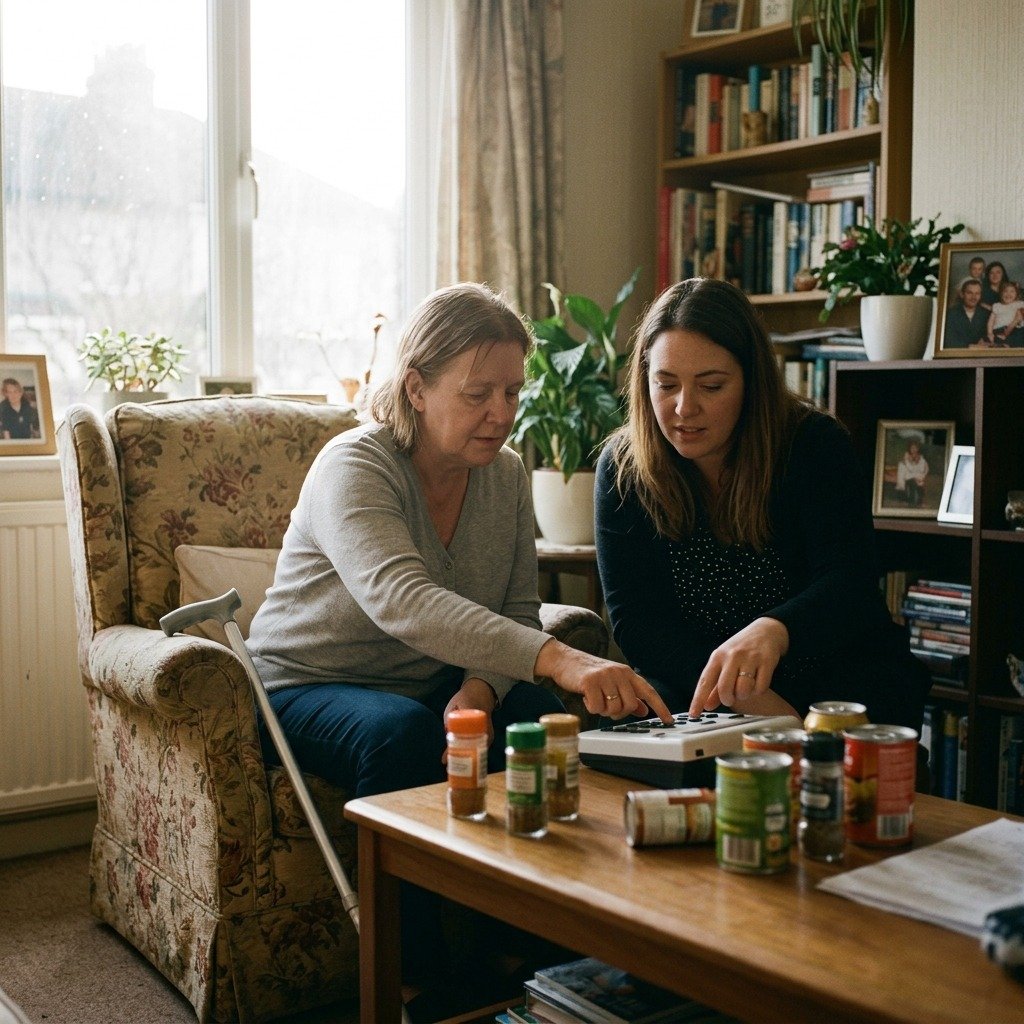
Attendance Allowance Blind: Benefits for Sight-Impaired Claimants
Sight loss whether registered or not can qualify you for Attendance Allowance at either the lower rate (£76.70/week) or higher rate (£114.60/week) from April 2026. The DWP awards based on functional care needs, not diagnosis alone. A Certificate of Vision Impairment (CVI) is your strongest piece of evidence, but it is not required to claim.
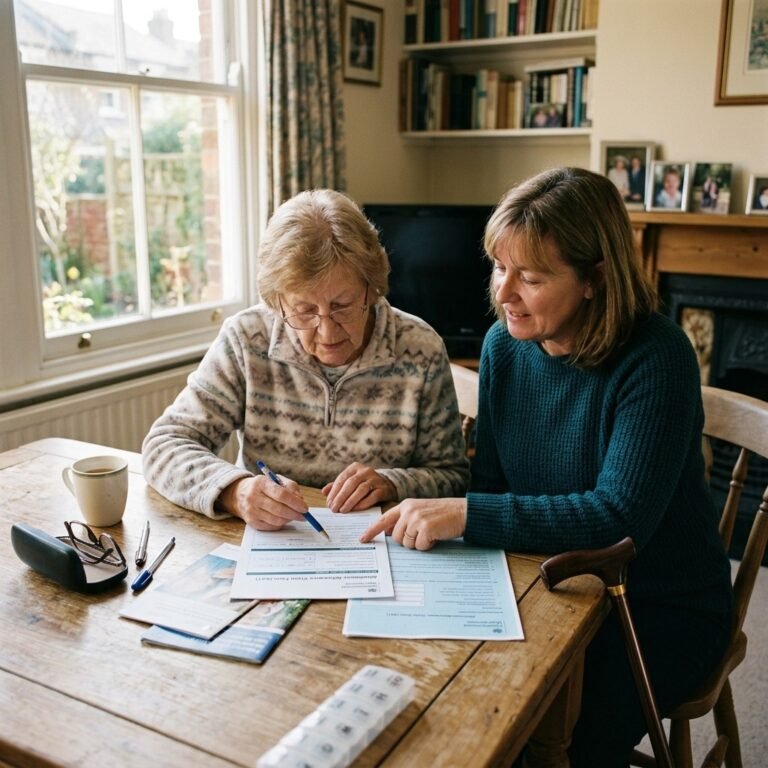
For a full explanation of Attendance Allowance rates, eligibility , the AA1 form, and the benefits cascade, see our Attendance Allowance homepage. This page covers only what is unique to sight loss claims.
What Is the Certificate of Vision Impairment (CVI) and How Does It Affect Your AA Claim?
Who issues the CVI?
A CVI is completed by a consultant ophthalmologist not a GP, not a high-street optician. In England, the ophthalmologist certifies the individual after measuring both visual acuity and field of vision. The CVI is then sent to your local council’s social services and to your GP.
The two registration categories
The CVI recognises two distinct levels of sight loss:
- Severely sight impaired (blind): For individuals with the most significant sight loss, affecting both acuity and field
- Sight impaired (partially sighted): For those with meaningful but less severe functional vision loss
Registration under either category is voluntary. Certification (stage one) and registration with your local council (stage two) are separate processes.
Severely sight impaired what visual acuity qualifies?
According to the RNIB, you may be certified as severely sight impaired if your vision (wearing glasses or lenses if needed) falls into one of these categories:
- Visual acuity of less than 3/60 with a full visual field
- Visual acuity between 3/60 and 6/60 with a severe reduction in field of vision, such as tunnel vision
- Visual acuity of 6/60 or above but with a very reduced visual field especially if the lower portion is significantly missing
Sight impaired visual acuity criteria
You may be certified as sight impaired if:
- Visual acuity is 3/60 to 6/60 with a full visual field
- Visual acuity is 6/60 to 6/24 with a moderate field reduction, cloudiness, or lens removal without replacement
- Visual acuity is 6/18 or better but a large portion of the visual field is missing (for example, half of your vision, or significant peripheral loss)
How to get a copy of your CVI for the AA1
Request a copy from your ophthalmology team or your local council’s sensory services department. Attach the original or a clear copy to your AA1 form. It is the single most valuable piece of supporting evidence a sight loss claimant can include.
Wales optometrist certification
In Wales, optometrists (not just hospital ophthalmologists) can certify visual impairments and issue the CVIW form. If you live in Wales and have not been offered certification, speak to your optometrist directly.
You don’t need to be registered to claim but registration helps enormously
The DWP does not require a CVI to award Attendance Allowance. What it assesses is your functional care need. However, a CVI gives your claim instant medical credibility and describes the clinical severity of your impairment in terms DWP decision-makers recognise.
Severely Sight Impaired the Higher-Rate Route
Why blind registration often leads to a higher-rate award
The higher rate (£114.60/week from April 2026) applies when you need care or supervision both during the day and at night. Severely sight impaired individuals typically meet this threshold because the risks present during daylight hours unrecognised hazards, medication errors, cooking dangers do not disappear after dark. They often intensify.
24-hour supervision framing for safety
Frame your claim around the concept of continuous supervision rather than individual care tasks. A severely sight impaired person who cannot identify spills, detect smoke damage, or recognise an intruder is not just inconvenienced they are at genuine risk of harm without oversight or reasonable precautions in place.
The “night is different for blind people” argument
Sighted people compensate for darkness using memory and environmental cues. A severely sight impaired person has no additional disadvantage from night. But falls, disorientation after waking, inability to read a thermometer during illness, and difficulty reaching a phone or emergency button all represent real night-time care needs the AA1 must capture.
Documentation to include
Attach your CVI, visual field test results, and any low vision clinic or rehabilitation officer assessment to the form.
Sight Impaired (Partially Sighted) the Lower-Rate Route
Functional impact vs registration status
Partial sight affects people very differently depending on which part of the visual field is impaired. Two claimants with the same Snellen score may have entirely different functional limitations. The AA1 must describe what you cannot do safely and independently not just your diagnosis.
Field of vision loss (glaucoma) impacts
Peripheral field loss from glaucoma creates specific hazards: not seeing people approaching from the side, misjudging steps and kerbs, failing to notice obstacles on the floor. These are care and supervision needs, not just mobility needs.
Central vision loss (macular degeneration) impacts
Central vision loss from conditions like age-related macular degeneration (AMD) affects reading, face recognition, and fine tasks. Claimants cannot read medication labels, identify who is at the door, or safely check food packaging without help.
Contrast sensitivity issues
Many sight-impaired people have relatively intact acuity scores but profoundly reduced contrast sensitivity making it impossible to distinguish a clear liquid from an empty space, or to see the edge of a step on a pale floor. This rarely appears on clinical letters but should be described in detail on the AA1.
Common Eye Conditions and AA Claims
Age-related macular degeneration (AMD)
AMD is the UK’s leading cause of sight loss in older adults. Central scotoma (blind spot) prevents safe reading, face recognition, and medication management. Both dry and wet AMD can support a claim; wet AMD with treatment complications (injections, infection risk, post-procedure limitations) adds further care needs.
Glaucoma and field loss
Peripheral field loss is often insidious claimants may not realise how much their field has narrowed until hazard incidents occur. Describe specific events: tripping over items not seen, bumping into furniture, failing to notice a gas hob left on.
Diabetic retinopathy
Diabetic retinopathy involves fluctuating vision and is closely linked to diabetic management complexity. For details on combining diabetes care needs with sight loss on the AA1,
Cataracts pre-surgery and post-complications
Pre-surgery cataracts can cause significant glare sensitivity, reduced acuity, and halos around lights all affecting daily care tasks. After surgery, complications such as posterior capsule opacification or infection can create new or extended needs. A claim during the 6-month waiting period is entirely valid if functional care needs are present.
Retinitis pigmentosa in older adults
RP typically presents with night blindness first, progressing to tunnel vision. Older adults with RP often have well-established tunnel vision by the time they are of state pension age. Night-time care needs are frequently severe and should be documented in detail.
Post-stroke visual field loss
Hemianopia (loss of half the visual field) following a stroke is often missed by DWP assessors unfamiliar with neurological causes of sight loss. A claimant with right hemianopia cannot safely read correspondence, identify hazards on the affected side, or navigate a kitchen without specific support. Include the neurological cause explicitly in the AA1.
Daily Care Needs for Sight Loss How to Describe Them on the AA1
Medication identification and dosing
Cannot distinguish tablet shapes or read packaging. Risk of taking wrong dose or wrong medication without someone to identify and prepare each dose.
Reading essential correspondence
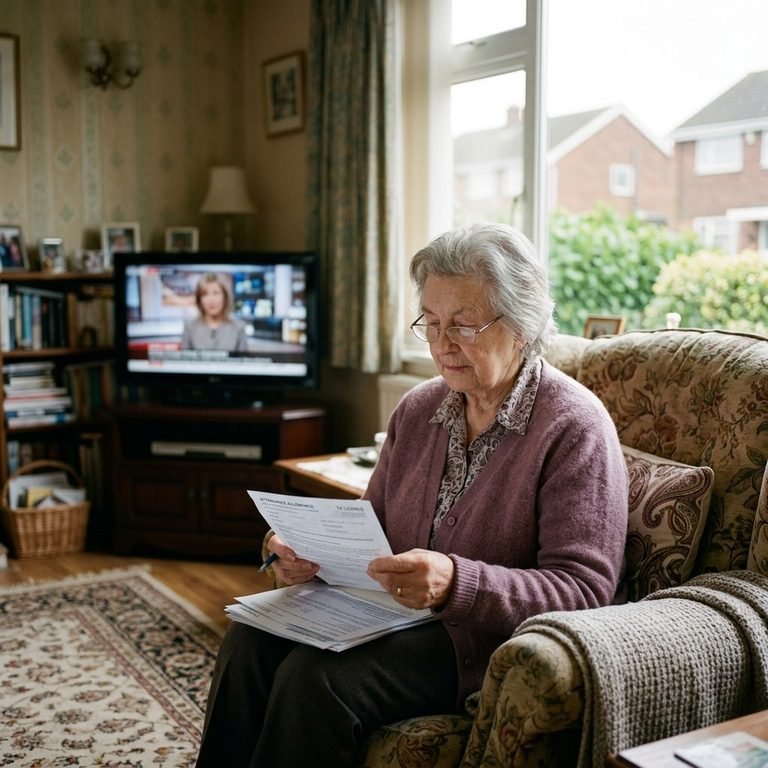
Cannot read bills, appointment letters, prescriptions, or benefit forms without assistance. Requires a helper to read and explain all incoming correspondence.
Cooking safety
Cannot safely use the hob (undetected spillover, flame left on), read oven temperatures, or judge whether food is cooked. Needs supervision or physical help when preparing hot food and drinks.
Bathing
Cannot accurately gauge water temperature by sight. Cannot reliably identify dirt or skin conditions requiring attention. Requires assistance with water testing and body-area checks.
Dressing
Cannot match clothes by colour, check for staining, or assess cleanliness. Requires daily clothing selection assistance.
Personal grooming
Cannot safely shave, check dental hygiene, or assess hair/nail cleanliness without tactile guidance or verbal assistance.
Mobility indoors and fall risk
Cannot recognise dropped items, wet floors, or furniture repositioned by others. At significant risk of falls without regular environment-checking by another person.
Handling money and correspondence
Cannot identify banknotes, read labels, or process written information independently.
Safety Supervision Needs Specific to Sight Loss
- Smoke alarm response: Cannot locate or verify source of alarm; needs someone present to assist with evacuation
- Answering the door: Cannot identify who is at the door before opening; vulnerability to deception or harm
- Recognising deliveries and post: Cannot read sender details, package labels, or unfamiliar correspondence
- Detecting spills and breakages: Glass fragments, liquids, or fallen objects go undetected, creating injury risk
- Emergency evacuation: Cannot independently navigate to exits in unfamiliar or disrupted environments
Weak vs Strong AA1 Wording 12 Sight Loss Examples
| Task | Weak wording (will not score) | Strong wording (will score) |
| Reading medication bottles | “I can’t see the labels well” | “I cannot read my medication labels and risk taking the wrong dose or doubling up without someone identifying each tablet for me daily” |
| Checking food packaging dates | “I struggle to read packaging” | “I cannot read best-before dates and have unknowingly used spoiled food; I need someone to check all packaging before I cook” |
| Identifying dropped tablets | “I drop tablets sometimes” | “When I drop a tablet, I cannot locate it safely there is a risk of later ingestion or a fall from kneeling to search; I need help finding and replacing them” |
| Safe hot drink preparation | “I’m careful making tea” | “I cannot see the water level in the kettle or determine when milk has been added; I need verbal guidance or physical help each time to avoid scalding” |
| Matching clothes | “I find it hard to get dressed” | “I cannot match clothes by colour or check for visible staining; I need someone to select and check each item daily to maintain appropriate dress” |
| Bathing temperature checks | “I run my own bath mostly” | “I cannot assess water temperature visually and have no reliable way to judge heat before entering; without someone testing the temperature, I risk scalding” |
| Navigating stairs | “Stairs can be tricky” | “I cannot see items left on stairs or changes in surface colour indicating the edge of a step, and I have fallen twice in the past six months; I need someone to check and assist me on the stairs” |
| Responding to visitors | “I prefer not to answer the door alone” | “I cannot identify who is at the door before opening it and am at risk of admitting strangers I believe to be familiar; I need someone present to verify callers” |
| Handling incoming post | “I get someone to help with letters” | “I cannot read any incoming correspondence bills, medical letters, or benefit forms without someone reading and explaining each item; I need this help at least weekly” |
| Using kitchen appliances safely | “I’m cautious in the kitchen” | “I cannot see whether the hob ring is lit or determine if a burner has been left on; I cannot read oven settings or see inside pans safely; I need supervision throughout every cooking activity” |
| Identifying spills | “I sometimes miss spills” | “I cannot detect liquids or broken glass on the floor and have slipped on undetected spills; I need someone to regularly check surfaces to prevent falls and injury” |
| Response to house alarm | “Alarms worry me” | “When my smoke alarm activates, I cannot identify the source of danger or navigate to an exit under stress; without a person present to assist me, I cannot safely evacuate” |
The Night Care Case for Sight Loss
Toilet navigation without vision
Navigating to the bathroom at night involves the same hazards as daytime undetected obstacles, disorientation in a familiar but dark room with the added factor of reduced alertness. Falls during nighttime toilet trips are a documented risk in sight-impaired older adults.
Response to a medical emergency
A sight-impaired person who feels unwell during the night cannot read a thermometer, identify medication, or reliably locate a phone. The difficulty of summoning help when disoriented in darkness is a genuine overnight care need.
Fall risk from unrecognised obstacles
Any object moved from its established position during the day creates a night-time hazard. Severely sight-impaired individuals cannot locate and clear obstacles before navigating the room.
Night presence paid or family
If a family member sleeps nearby to assist, or paid overnight care is in place, state this explicitly. The DWP asks what care you need whether or not that need is currently being met is secondary.
Combined Sensory Impairment Sight and Hearing Loss Together
Dual sensory loss and care escalation
Dual sensory impairment where both sight and hearing are significantly reduced dramatically escalates care needs beyond what either impairment alone would produce. A person who cannot see approaching hazards and cannot hear warning sounds has almost no environmental safety feedback.
The Sense assessment framework for dual sensory loss
Sense the national charity for people with complex disabilities including deafblindness provides assessments and descriptors for combined sensory loss. A Sense assessment letter describing the combined functional impact of sight and hearing loss is a powerful piece of supporting evidence.
How to describe combined impact on the AA1
Do not describe sight loss and hearing loss separately. Describe their combined effect on each task: “I cannot identify approaching people by sight or sound, and cannot hear verbal warnings about hazards I cannot see.”
Deafblind UK
Deafblind UK offers support, advocacy, and assessment services for people with combined sensory impairment. Contact them at deafblind.org.uk for support in building your AA1 case.
Evidence to Strengthen a Sight Loss Claim
Attach as many of the following as you can source:
- Certificate of Vision Impairment (CVI): Your most valuable document attach a copy
- Ophthalmology consultant letters: Any letters describing diagnosis, acuity, and prognosis
- Visual field test reports: Especially where field loss is a key aspect of your claim
- OCT (Optical Coherence Tomography) reports: Particularly useful for AMD and glaucoma claims
- Low vision clinic assessment: Describes functional impact in a format DWP assessors understand
- Rehabilitation Officer for Visually Impaired (ROVI) report: Documents specific care adaptations you need
- Guide Dogs UK letter: If you are a guide dog owner, this confirms the severity of your sight loss
Adjacent Support and Concessions for Registered Sight-Impaired People
Attendance Allowance is not the only financial support available. Once registered:
- Blind Person’s Tax Allowance: £3,250 added to your personal tax-free allowance in 2026/27 (up from £3,130 in 2025/26), confirmed by HMRC
- 50% TV Licence reduction: Available to those registered as blind or severely sight impaired (GOV.UK)
- Free directory enquiries: The 195 service is available to blind and partially sighted people who cannot use a standard directory; call 0800 587 0195 to register (RNIB)
- Disabled Person’s Railcard: One-third off most rail fares; available to those registered as sight impaired
- Blue Badge: CVI holders are eligible for a Blue Badge parking permit
Sight Loss-Specific Pitfalls What Ruins Otherwise Valid Claims
Assuming your CVI alone wins the claim. The DWP awards AA based on care needs, not diagnosis. Your CVI is evidence of severity it is not a substitute for describing how your sight loss affects daily tasks.
Describing diagnosis rather than function. “I have macular degeneration” tells the DWP nothing about your care needs. “I cannot read my medication labels, check food packaging, or identify who is at my door” does.
Missing hazard recognition needs. The inability to see spills, obstacles, or environmental dangers is a supervision need. This is often the most overlooked section of a sight loss claim.
Underplaying night-time care. Many sight-impaired claimants describe only daytime needs and miss the higher rate as a result.
Not attaching the CVI copy. It is the one document most likely to prompt an immediate favourable decision. Don’t omit it.
Focusing on outdoor mobility. Difficulty walking outdoors, navigating unfamiliar environments, and using public transport are PIP concerns not AA. Keep your AA1 focused on personal care and supervision needs in and around the home.
Frequently Asked Questions
Do I need to be registered blind to claim Attendance Allowance?
No. Registration as sight impaired or severely sight impaired is voluntary and not required for a successful AA claim. The DWP assesses your functional care needs, not your registration status. However, a CVI significantly strengthens your claim.
Does my CVI need to be recent?
There is no official expiry date on a CVI. However, a recent ophthalmology letter or updated visual field report showing current severity is more persuasive than a CVI issued several years ago, particularly if your condition has progressed.
What if I have only lost sight in one eye?
Sight loss in one eye alone generally does not qualify for CVI certification, because the remaining eye compensates significantly. However, if you also have conditions affecting the other eye even less severely the combined functional picture may still support an AA claim based on care needs.
Do cataracts qualify for Attendance Allowance?
Yes, if the functional impact creates genuine care needs. Pre-surgery cataracts with severe glare, halos, or acuity reduction can qualify. Complications following surgery or a long wait for the procedure may extend the qualifying period.
Does AMD progressive loss qualify?
Yes. Both dry and wet AMD qualify where there is a central scotoma affecting daily tasks. Progressive AMD means care needs are likely to increase over time; document current needs precisely and note the progressive nature of the condition.
What visual acuity do I need to qualify for Attendance Allowance?
There is no minimum visual acuity requirement for AA. The benefit is based on care and supervision needs, not Snellen score. Someone with relatively preserved acuity but severe field loss may have greater care needs than someone with poor acuity but full field.
Can I claim if my sight loss is stable?
Yes. Stability does not remove care needs. A claimant whose vision stabilised two years ago still has the same daily care requirements as when the condition was active. The AA eligibility question is whether you currently need help not whether your condition is still progressing.
Does having a guide dog affect my Attendance Allowance claim?
A service dog can provide supporting evidence of your sight loss. It does not replace the need for human care or supervision for tasks the dog cannot help with, such as medication identification, correspondence, cooking, and bathing. Include a supporting letter from the organisation that provides your dog, if available.
2 Comments