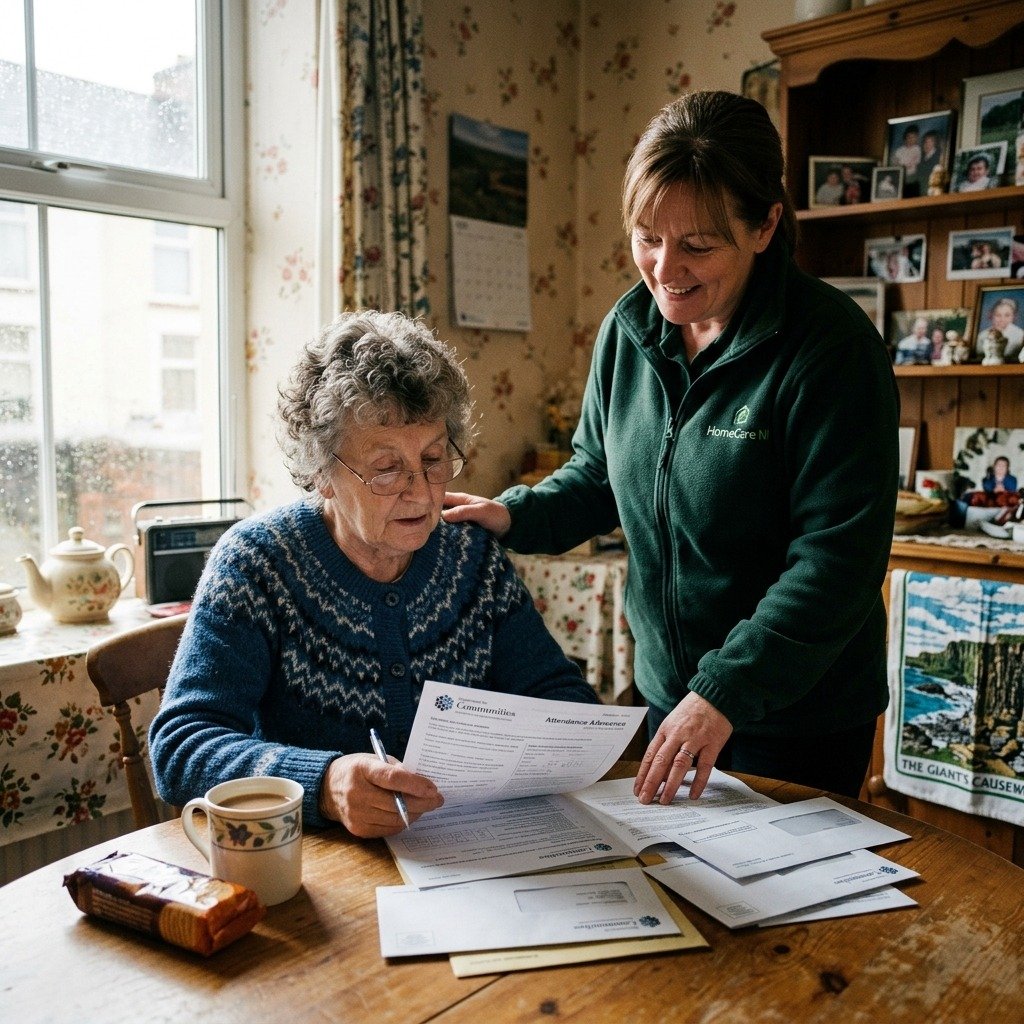
Attendance Allowance Northern Ireland: Rates, Eligibility & How to Claim
Attendance Allowance in Northern Ireland pays the same rates as the rest of the UK (£76.70 lower rate, £114.60 higher rate for 2026/27), but it’s administered separately. Claims go through the Department for Communities’ Disability and Carers Service (DCS), not the DWP, and applications are made via nidirect.
Who Administers Attendance Allowance in Northern Ireland?
Northern Ireland doesn’t use the Department for Work and Pensions (DWP). Instead, the Department for Communities (DfC) is the devolved government department responsible for social security, and it delivers Attendance Allowance through its Disability and Carers Service (DCS).
The DCS handles applications, medical evidence, decision-making, and ongoing case management for Attendance Allowance, Disability Living Allowance, and Carer’s Allowance in Northern Ireland. This is functionally equivalent to what the DWP does in England, Wales, and (for a related benefit) Scotland, but it operates under separate NI legislation.
nidirect.gov.uk is the official government portal for Northern Ireland residents. It’s where you’ll find the application service, downloadable claim forms, and guidance notes specific to NI claimants. If you search for Attendance Allowance and land on GOV.UK instead, you’ll be redirected to nidirect for the actual claim process.
Despite the different administration, the rates and rules are the same as in England and Wales. For 2026/27, that’s £76.70 a week at the lower rate and £114.60 a week at the higher rate.
NI Attendance Allowance Contact Details
If you need to speak to someone about a claim, contact the Disability and Carers Service directly:
- Freephone: 0800 587 0912
- Textphone: 0800 012 1574
- Email: dcs.forms@dfcni.gov.uk (to request a claim pack)
- British Sign Language (BSL) or Irish Sign Language (ISL): available through the DCS video relay service
You can also visit a local Jobs and Benefits office to collect a form or hand in a completed application. If you request a form by phone or email, that contact date becomes your claim date as long as you return the form within six weeks.
How to Apply in Northern Ireland
There are three main routes into a Northern Ireland Attendance Allowance claim:
Apply online. The nidirect Attendance Allowance service links through to an online application. You’ll need your National Insurance number, contact details, GP or medical centre information, and details of any time spent living abroad.
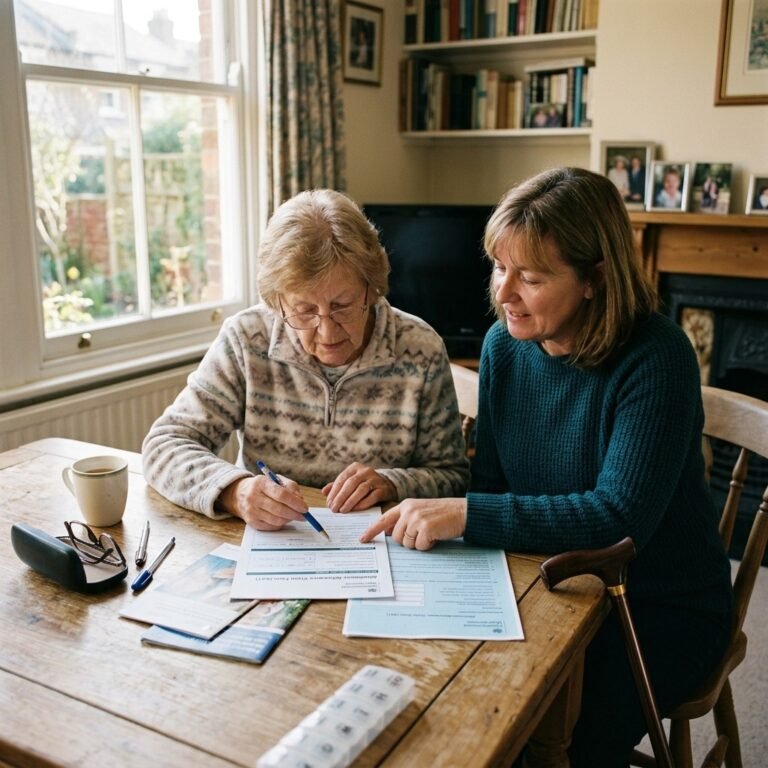
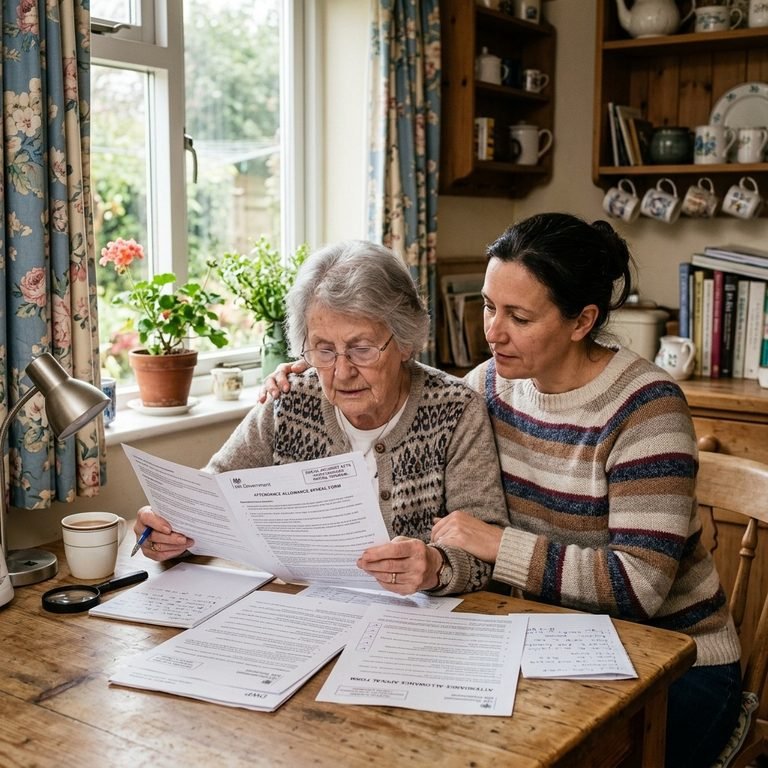
Download the NI-specific claim form. Northern Ireland uses its own version of the claim form the AA1 claim form and guidance notes available for download from nidirect. You can complete it digitally before printing, or print it first and fill it in by hand.
Request a form by phone or email. Call the DCS or email dcs.forms@dfcni.gov.uk with your name, address, and the type of form needed. This method backdates your claim to the date of your request.
Completed forms can be posted to the Disability and Carers Service or dropped off at your nearest Jobs and Benefits office.
What’s Different About the NI Process
The application form itself covers the same ground as the version used elsewhere questions about washing, dressing, eating, mobility, medication, and supervision needs. The real differences lie in administration.
Decision-making happens through DCS, not the DWP. Once your form arrives, a decision maker from the Disability and Carers Service reviews it, rather than a DWP case handler.
Processing typically takes around 30 working days from the date DCS receives your form. Claims made under the special rules for end of life are fast-tracked and processed far more quickly.
Appeals go to a different body. If you disagree with a decision, you can ask for a mandatory reconsideration first. If you’re still unhappy, appeals in Northern Ireland go to the Appeal Service (Northern Ireland), not HM Courts and Tribunals Service, which handles GB appeals.
Residence rules reference Northern Ireland specifically. To qualify, you generally need to be habitually resident in Northern Ireland and have spent at least two of the last three years in Northern Ireland, Great Britain, the Isle of Man, Jersey, or Guernsey.
The Republic of Ireland Cross-Border Situation
Northern Ireland’s land border with the Republic of Ireland creates a genuinely unique wrinkle that doesn’t apply anywhere else in the UK.
The Common Travel Area (CTA) covering the UK, Ireland, the Channel Islands, and the Isle of Man underpins how residence is assessed for claimants with ties on both sides of the border. Being habitually resident within the CTA can support a claim even if some time was spent in the Republic.
If you live in the Republic of Ireland, you may still be able to claim UK Attendance Allowance in certain circumstances, including if you:
- work in the UK or pay UK National Insurance contributions
- receive a UK State Pension
- receive Industrial Injuries Benefit
- receive contribution-based Employment and Support Allowance
- receive UK bereavement benefits
Whether this applies depends heavily on your individual connection to the UK social security system, so it’s worth getting advice from a cross-border specialist like Border People before assuming either way.
Temporary travel abroad including trips to the Republic of Ireland doesn’t usually stop your payments. You can generally keep receiving Attendance Allowance for up to 13 weeks away, or up to 26 weeks if you’re abroad for medical treatment, as long as you report your travel to DCS.
Passported Benefits in Northern Ireland
An Attendance Allowance award can unlock or increase other support in Northern Ireland, mirroring but not identically matching the GB system:
- Pension Credit: an extra amount for severe disability may be added once AA is in payment.
- Housing Benefit: similarly, a severe disability premium can apply.
- Rate Rebate: Northern Ireland doesn’t have Council Tax it has a domestic rates system instead. Rate Rebate is the NI equivalent of Council Tax Reduction, administered through Land & Property Services (LPS).
- Blue Badge scheme: getting Attendance Allowance doesn’t automatically qualify you for a Blue Badge in NI, but it can support an application, which is assessed separately.
- Translink concessionary travel: NI residents aged 60 and over may be eligible for a SmartPass rather than the Disabled Persons Railcard used in England and Wales, which isn’t available in Northern Ireland.
Because Attendance Allowance is normally ignored as income for these calculations, it’s worth requesting a full benefits check once your award comes through many claimants find they’ve become newly eligible for support they weren’t getting before.
The NI Housing Executive Interaction
Housing in Northern Ireland works differently to England’s local authority model. The Northern Ireland Housing Executive (NIHE) is the region’s strategic housing authority and largest social landlord, and it plays a direct role for many AA claimants.
If you rent from NIHE, your Housing Benefit is typically administered in connection with your tenancy. If you’re a private tenant or homeowner, Rate Rebate is handled through LPS rather than a local council, since Northern Ireland has no local-authority equivalent for this function. Disability-related adaptations to social housing are also arranged through NIHE, and an Attendance Allowance award can help support a case for home adaptations or a rent-related disability premium.
NI Health Service Differences
Northern Ireland’s health and social care system is structurally different from England’s NHS. It’s called Health and Social Care (HSC), and it integrates health and social services under one umbrella through five regional HSC Trusts, rather than splitting them across separate NHS and local authority systems.
This matters for Attendance Allowance claimants because care assessments, occupational therapy reports, and care packages usually come from your local HSC Trust rather than a council social services department. Unlike Scotland, Northern Ireland does not currently offer universal free personal care Attendance Allowance remains an important source of income to help cover care costs, even though it isn’t means-tested and doesn’t have to be spent on care specifically.
Moving Between NI and Great Britain
If you move from Northern Ireland to England, Wales, or vice versa, your Attendance Allowance entitlement generally transfers without requiring a brand-new claim the benefit exists in both jurisdictions under equivalent rules. What changes is who administers it.
- Moving from NI to GB: notify DCS of your move; your case is generally handed over so the DWP can take over administration.
- Moving from GB to NI: notify the DWP; your case transfers to DCS.
The one jurisdiction where this doesn’t apply cleanly is Scotland, which replaced Attendance Allowance with Pension Age Disability Payment a different benefit administered by Social Security Scotland. Moving between NI and Scotland involves a genuine change of benefit, not just a change of administrator.
Regional Advice Services in Northern Ireland
Northern Ireland has its own network of independent advice organizations, separate from Citizens Advice England and Wales:
- Advice NI: 0800 915 4604 general benefits queries and a dedicated welfare changes helpline
- Age NI: 0808 808 7575, Monday to Friday, 9am to 5pm benefits information for older people
- Law Centre NI: specialist legal advice, including benefits appeals
- Local Independent Advice Centres: community-based support for form-filling and appeals across NI
These services are especially useful if a previous claim was refused, your needs vary day to day, or you’re navigating a move into residential care.
NI Attendance Allowance Statistics
According to accredited official statistics published by the Northern Ireland Statistics and Research Agency (NISRA) in May 2026, there were 67,760 Attendance Allowance claimants in Northern Ireland as of February 2026 an increase of 3,580 claimants, or 6%, compared with February 2025. Over the same period, State Pension claimants in NI reached 334,910. The upward trend suggests growing awareness of the benefit among eligible pensioners, though take-up is still thought to lag behind full entitlement.
NI Political Context and Benefit Changes
Social security is a devolved matter in Northern Ireland, meaning the NI Executive not Westminster sets the direction for welfare policy locally, even though most benefit rates and structures mirror GB.
In December 2024, the Executive agreed to extend Welfare Supplementary Payment mitigation schemes for a further three years, running to March 2028. These payments protect claimants from measures like the Benefit Cap and the Social Sector Size Criteria (“bedroom tax”), with a projected funding requirement of £47.3 million for 2025/26 alone. Attendance Allowance itself isn’t a target of these mitigations, since it hasn’t been cut, but the extension signals a broader political commitment in Northern Ireland to cushioning welfare reform impacts more than has happened in England.
There’s no indication that Northern Ireland plans to follow Scotland’s lead in replacing Attendance Allowance with a devolved equivalent like the Pension Age Disability Payment. For now, NI claimants remain within the same benefit as England and Wales, just under separate administration.
Common NI-Specific Issues
A few practical snags come up repeatedly for Northern Ireland claimants:
Correspondence confusion. Some online application journeys route through a DWP-branded web address (even though the claim itself is processed by DCS), which can leave claimants unsure who’s actually handling their case.
Cross-border evidence gaps. Claimants who’ve split time between Northern Ireland and the Republic of Ireland sometimes struggle to evidence habitual residence, particularly where employment or medical records sit on the Irish side of the border.
SmartPass vs. Railcard confusion. Claimants who’ve previously lived in England may expect to apply for a Disabled Persons Railcard, only to find it isn’t available in Northern Ireland and that Translink’s SmartPass system works differently.
Frequently Asked Questions
Is Attendance Allowance the same in NI as in England?
The eligibility rules and payment rates are the same, but administration differs. Northern Ireland claims go through the Department for Communities’ Disability and Carers Service rather than the DWP.
Do I apply through GOV.UK or nidirect?
Northern Ireland residents should use nidirect.gov.uk. GOV.UK guidance will redirect NI users to the correct nidirect service.
Who processes my NI application?
The Disability and Carers Service (DCS), part of the Department for Communities, processes and decides Northern Ireland claims.
Are the rates the same in NI?
Yes. For 2026/27, the lower rate is £76.70 a week and the higher rate is £114.60 a week identical to England and Wales.
What if I move to Scotland from NI?
You’ll need to apply for Pension Age Disability Payment instead, since Scotland has replaced Attendance Allowance with this separate, Social Security Scotland-administered benefit.
Can I use my NI Attendance Allowance in the Republic of Ireland?
Payments can usually continue for temporary stays of up to 13 weeks (or 26 weeks for medical treatment), but permanent relocation to the Republic requires individual assessment of your ongoing entitlement.
Is the form the same as the GB AA1?
Northern Ireland has its own AA1 claim form and guidance notes, downloadable from nidirect, though the questions closely mirror the GB version.
What’s the Disability and Carers Service?
It’s the Department for Communities agency responsible for delivering Attendance Allowance, Disability Living Allowance, and Carer’s Allowance across Northern Ireland.